
David Cooper | January 28, 2026 | @PurpleBerryCOL
Cover photo credit: mlb.com
The Colorado Rockies’ home road splits aren’t just about Coors Field—they’re about adjustment. Every baseball fan knows the Rockies have exaggerated home/road splits, and every baseball fan knows the reason: Coors Field. Even in a historically poor 2025 season, the Colorado posted a .309 winning percentage at 20th and Blake, compared to just .222 on the road.
The fact that Coors Field inflates offensive numbers is no secret. What’s less appreciated is how deflated the road numbers can be—and why. Other ballparks don’t offer an extra ~8 feet of carry on fly balls or 2.79 acres of outfield grass, both of which dramatically raise the margin of error. But the biggest adjustment happens before the ball is even put in play.
Pitches break roughly 80% as much at Mile High as they do at sea level. A curveball with 12 inches of induced break elsewhere only breaks ~9.5 inches at Coors Field. For hitters who spend half their season perfecting timing and swing paths to that environment, every road trip demands a recalibration.
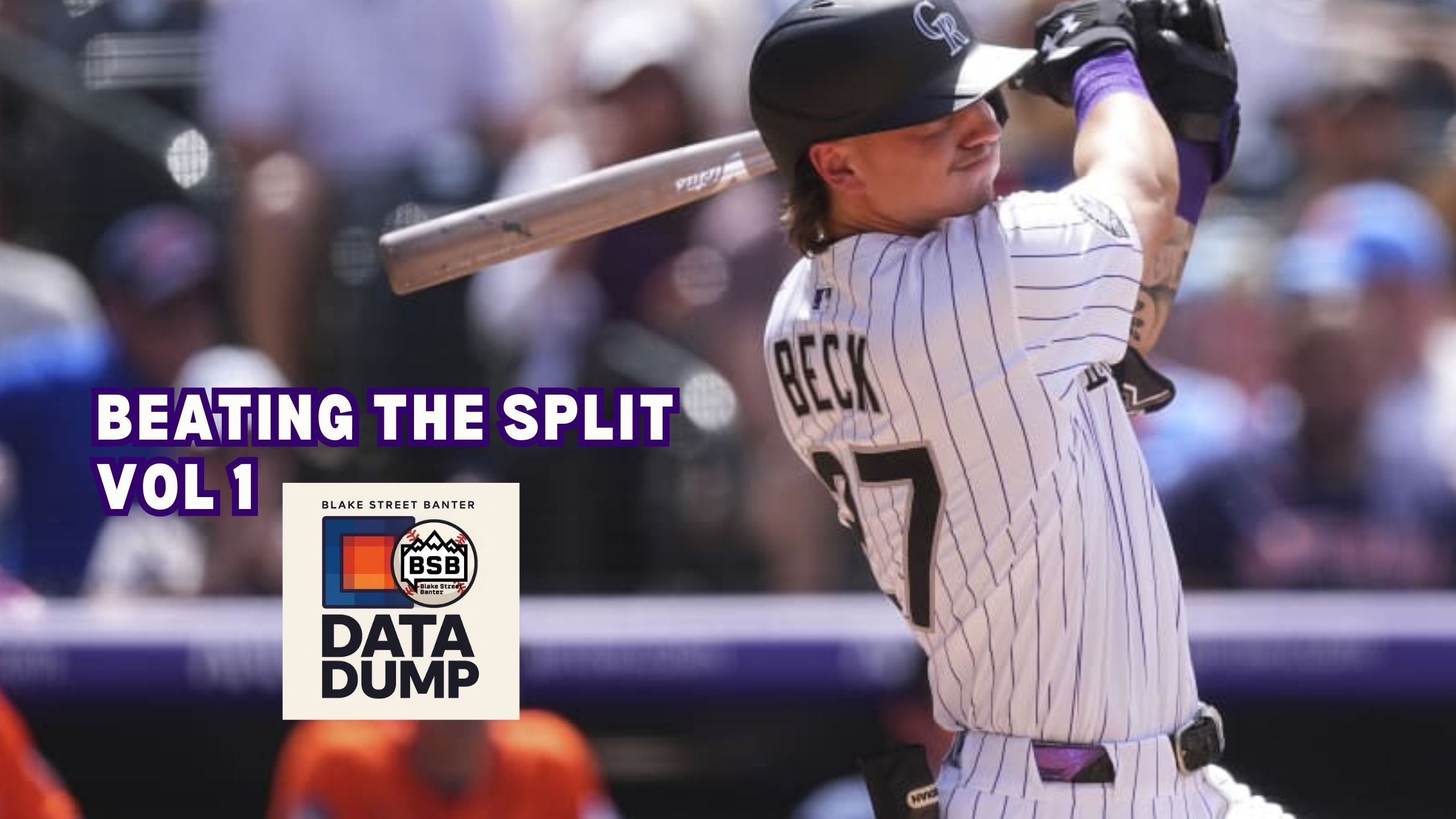
Hitting in the big leagues is already hard enough against elite velocity and movement. Asking hitters to repeatedly recalibrate to sharper pitch movement only compounds the challenge. Rockies hitters Hunter Goodman and Jordan Beck discussed this exact issue on a recent MLB Central interview, where Beck noted that it can take up to three days to feel comfortable on a road trip.
That comment sparks a question worth investigating: do the numbers support Beck’s self-diagnosis?
In the first edition of Beating the Split, I’ll dive into how Rockies hitters adjust over the course of a road trip. Later in this series we’ll investigate what the data suggests about eventually narrowing the gap between Coors Field and everywhere else.
2025 Rockies Batters on the Road
Let’s start where Goodman and Beck left off: adjustment takes time. Looking at key mainstays in the 2025 Rockies lineup, I used MLB Savant data to compute each players’ hard hit rate and barrel rate across the first six days of road trips.
For Goodman, Beck, and Ezequiel Tovar the trend is clear. Both hard hit rate and barrel rate improve as the road trip progresses.

Goodman’s barrel rate climbs dramatically. While he barrels the ball at league-average levels (8.4%) early in a trip, by the second series, that figure nearly triples to ~23%. Beck and Tovar show similar recoveries in hard hit rate. Both begin road trips around a dismal ~20%, before climbing back toward the league average of 40.9%.
The timing of those adjustments, however, differs. Beck—just as he described on MLB Central—doesn’t show a meaningful increase in balls hit 95+ mph until Day 4. Tovar, by contrast, rebounds by the second game of the trip.
Rockies Offseason Acquisitions
The surface-level conclusion is straightforward: some hitters need time, others less so. But the more interesting question is why. Are these hitters struggling to adjust to fastballs or breaking balls? Are they rolling over or popping out? The answers vary hitter to hitter.
Below, I’ll briefly illustrate where these improvements actually come from.
Hunter Goodman’s Road Trip Adjustment
Goodman’s barrel rate nearly triples over the course of a six-game road trip, so launch angle is a natural place to look. A batted ball is classified as a barrel when it’s hit at 98+ mph within a narrow launch-angle window—generally between 26 and 30 degrees.
During Days 1–3 of a road trip, Goodman rarely turns fastballs around in that optimal zone. By Days 4–6, his launch angle distribution shifts noticeably toward the barrel window. The result is fewer wasted swings on hittable fastballs and a sharp rise in damage on contact.

Jordan Beck’s Road Adjustment Curve
Beck’s adjustment is more gradual and more complex. His slow climb in hard hit rate reflects improvements in both exit velocity and launch angle, across fastballs and breaking balls.
Breaking balls, however, tell the cleanest story. Early on road trips, Beck tends to club breaking pitches into the ground. As the trip progresses, those same benders are increasingly lifted into line drives and fly balls. This is an example of where the extra 3–5 inches of break—relative to Coors Field—can disrupt timing and contact quality.
By mid-trip, Beck is no longer rolling over pitches that previously dove under his barrel.

Ezequiel Tovar’s Fastball Adjustment
Tovar stands apart for how quickly he adjusts. His hard hit rate returns to ~40% after just one road game!
Hard-hit balls are defined as those struck 95+ mph. In the first game away from Coors, Tovar’s contact against fastballs lacks consistent authority. By the second game, nearly half of the fastballs he puts in play clear the hard hit threshold.
For Tovar, the fix is immediate and power based.

What about Mickey Moniak and Tyler Freeman?
Interestingly, Moniak and Freeman don’t show the same adjustment period. Their production remains relatively stable across ballparks, suggesting skill sets that translate more cleanly outside of Coors Field.
What makes them different—and whether that difference is teachable (or acquirable)—will be the focus of the future installments of Beating the Split.
What This Means for the Rockies’ Future
Building a winning Rockies lineup isn’t just about maximizing the offensive edge of Coors Field. It’s also about minimizing the penalty that comes with leaving it.
If the Rockies ever hope to bring home their first World Series title, the challenge of transitioning between Coors Field and opposing ballparks can’t be ignored—especially in the playoffs where the venue constantly changes.
For now, I’ll be tracking these adjustment metrics closely for Goodman, Beck, and Tovar throughout the 2026 season. As this young core gains experience—and with a newly revamped front office—will we see meaningful changes in preparation and performance away from the familiarity of Mile High?
Beating the split may start by acknowledging the reality of it.
Written by David Cooper.


3 responses to “Colorado Rockies Home Road Splits: Why Hitters Struggle Away From Coors Field”
-
[…] Beat the Split | Vol. 1 […]
-
[…] Colorado Rockies Home Road Splits: Why Hitters Struggle Away From Coors Field […]
-
[…] This second installment of Beating the Split investigates who are the Rockies hitters that have been successful at home and on the road, and what exactly separates them from the rest? Read Vol. 1 of Beating the Split here. […]
Blake Street Banter
About
Blake Street Banter: Your top source for Colorado Rockies news, analysis, player insights, and fan opinions. Join the Rockies community and stay informed!
Topics
Follow Us
Designed with WordPress
Leave a Reply