
Shawn Trewartha | March 13,2026
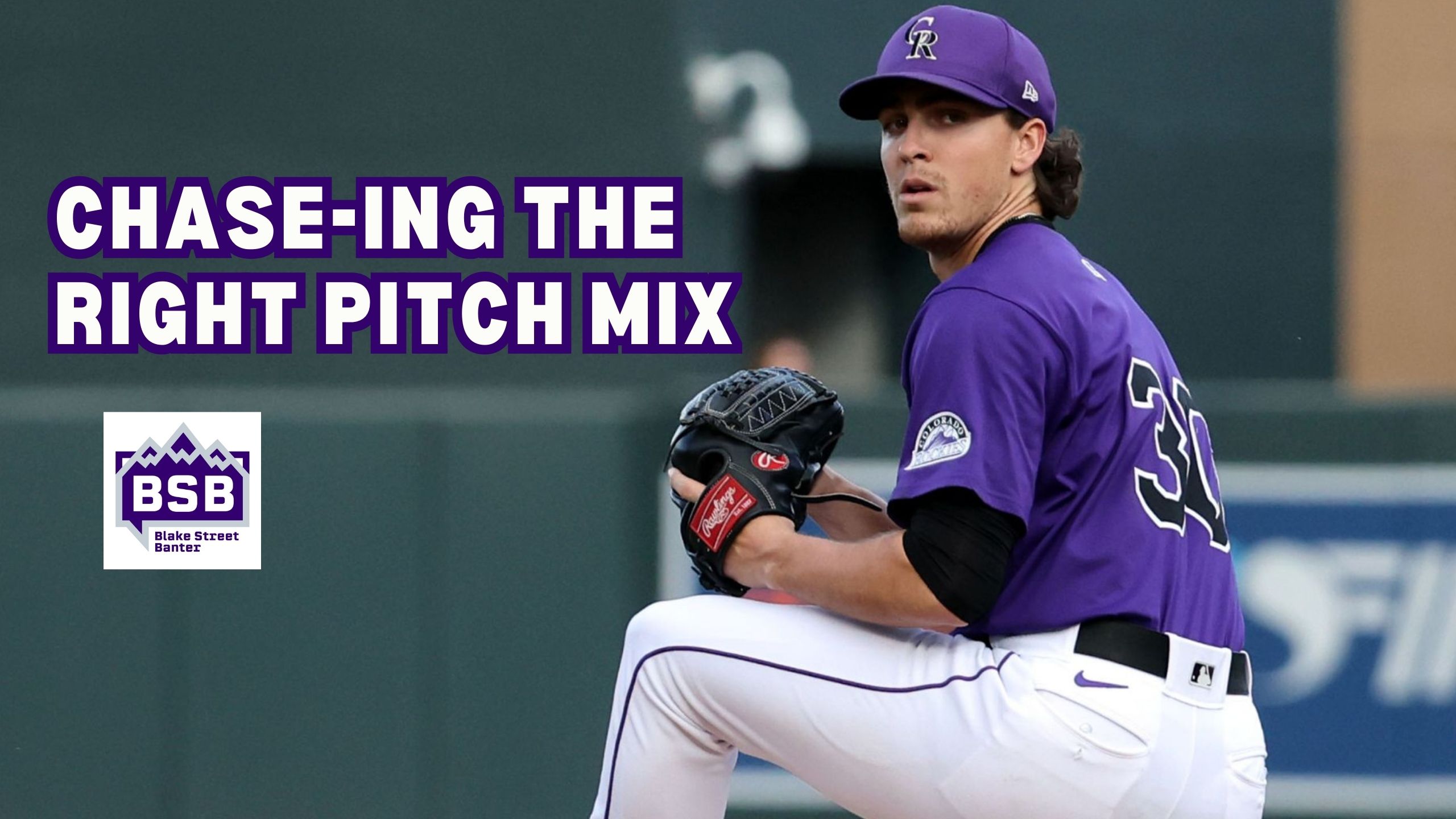
The hype train for Chase Dollander started long before he made his major league debut on April 6 of the 2025 season. After being drafted ninth overall out of Tennessee, he immediately became the most anticipated Rockies pitching prospect since Jon Gray was a minor leaguer in the mid 2010s. Unfortunately, in his first year in the big leagues, that hype did not match his production, leaving the Rockies looking for big improvements out of him in year two.
Dollander’s home/road splits tell the story of his up-and-down rookie campaign, posting a non-park-adjusted ERA of 3.49 on the road compared to a staggering 9.98 at Coors Field. That disparity alone echoes a familiar theme for Colorado pitchers; Dollander may simply be facing the same Coors Field problem that has derailed so many young Rockies arms.
It’s not fair to simply assume that Dollander will be like many other highly touted prospects before him who ultimately underperformed. His stuff is just too good to overlook, and there is a new regime in town that seemingly is committed to tackling this issue head-on. It is important to dive deeper into the data and determine what aspects of the game are working and which ones might need extra attention.

Fast Ball Command
Dollander’s fastball jumps off the page. He can dial it up to 100 MPH with regularity, with a respectable 11.5 inches of induced arm side break. However, you wouldn’t know that based only on its production; in 2025, his four-seamer achieved a whiff percentage of 20%, which is below the league average, and a 0.585 pitch-specific slugging percentage. His fastball is failing to miss bats, and when contact is made, it is often hit hard for extra bases.
By now, it’s no surprise that the home/road splits for the four-seam pitch-specific slugging percentage are concerning; 0.356 on the road and 0.769 at Coors Field. The leading driver of this disparity is high fastballs in the zone. Many of his fastballs are hit hard at Coors because the pitch’s movement averages about 2 inches more on the road than at home. A fastball that grazes the top of the strike zone on the road becomes much more hittable at Coors.

This is also highlighted when looking at Dollander’s Whiff % by zone. While on the road, his fastball is generating more swings and misses on pitches above the strike zone than he is capable of at Coors. The altitude limits the “raising” effect on the fastball, making the outside the zone fastballs less attractive to swing, and the in the zone fastballs more drivable.

Optimizing the Cutter
Moving onto his secondary fastball, his cutter. Chase threw the cutter 12% of the time in 2025, and it was the worst-performing pitch in his arsenal. The cutter generated swing and misses at a slightly higher rate than his four-seamer, but it was hit for a much higher slugging percentage. The data shows these fastball variants are not ideal pitches at altitude, and Chase’s cutter was no exception, generating a 0.905 SLG at Coors and 0.348 on the road. Generally speaking, he locates this pitch well horizontally and can catch the outer-third of the plate to right-handed batters. But at Coors Field, he is messing up far too often, leading to an expected SLG of 1.160 on the outer-middle portion of the plate.

Now, even when he positioned his cutter properly, it did not perform well because the generated movement was not consistently strong enough. Luckily, it appears that the Rockies have been working to address this. Historically, the data has borne out that downward breaking gloveside movement has a better chance at translating to Coors Field, and the early spring training metrics show that by increasing the spin rate by an additional 60 rpm on average Chase’s cutter is averaging 0.3 inches more vertical break and 1.6 inches more horizontal break which would be a huge improvement if translated to the regular season. In fact, in his 4 spring training starts, his cutter has generated a whiff percentage of 29%, and allowed only 1 hit. With the new regime, rightfully, emphasizing a strong secondary pitch arsenal, Chase is going to need a dominant cutter, and additional sweeping action is the key.
Attack with the breaking stuff
The last pitch worth discussing in detail is his Curveball. Far and away, Chase’s best pitch in 2025 was his breaking ball, which he used 21% of the time. It compiled a whiff percentage of 35.7 percent and a slugging of 0.207. What is more exciting is its productivity at Coors Field, where he managed to spin it to a 0.229 home SLG compared to a 0.179 on the road. More evidence to my argument that strong breaking pitches at Coors Field should not be shied away from; rather, they should be encouraged and championed as core components of a pitcher’s arsenal.

Looking at his curveball whiff percentage by zone, Dollander generates more swings and misses on the road. Which makes sense when comparing total movement, the curveball breaks 3 inches less while at home. This is not concerning, however, because the curveball is not generating strong contact at Coors, especially when it’s located in the corners.

This pitch was not infallible; mistakes were made, generally when the pitch was mislocated over the center of the plate. If he can dial that accuracy in and hit the bottom gloveside corner of the zone with more regularity, his curveball could be one of the best in the game.
Looking ahead
I don’t believe anything discussed above is news to Paul Depodesta and his new staff at 20th and Blake. All signs this off-season point to a more analytically driven approach in 2026, particularly when it comes to handling the pitching staff. That, combined with Chase Dollander’s raw arm talent, suggests the potential for a meaningful sophomore bounce-back if the Rockies can help him better navigate the unique challenge of pitching at Coors Field.
Early in spring training, there have been some inconsistencies with command leading to more walks than one would like, which hopefully should smooth out with a few more outings. More interesting are the adjustments to his pitch usage. Chase has thrown his four-seamer just 32% of the time so far while increasing his cutter usage to 18%, with both his changeup and sinker appearing more frequently than they did in 2025 as well. Some of this is likely intentional experimentation to build a feel for secondary pitches and manage workload early in camp, but the trends are encouraging. The only potential red flag is his curveball usage, sitting around 10%, a number that will almost certainly rise once the regular season begins.
In interviews this offseason, Chase has been candid about the areas he needs to improve, and he seems to have the right mentality to attack Coors Field head-on. Success will hinge on balancing his pitch mix, challenging hitters up in the zone with his fastball at home, adding more break to the cutter, mixing in his full arsenal to keep batters off-balance, and showing a willingness to dominate with the curveball in all counts. While the initial results were rough, the potential for excellence is just a few adjustments away.
Written by Shawn Trewartha.


Blake Street Banter
About
Blake Street Banter: Your top source for Colorado Rockies news, analysis, player insights, and fan opinions. Join the Rockies community and stay informed!
Topics
Follow Us
Designed with WordPress
Leave a Reply