
Eli Whitney | August 19, 2026
The call came on a bus.
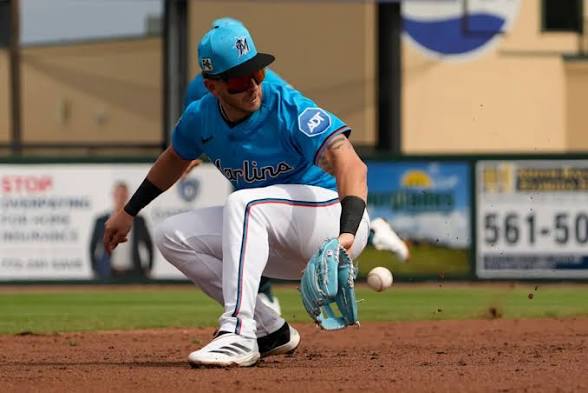
Connor Norby was riding to Gwinnett, Georgia, with the Triple-A Jacksonville Jumbo Shrimp on August 3 when the Marlins told him he’d been traded to the Rockies as part of the return for Victor Vodnik.
“I never thought really that I was going to be traded,” Norby said. “But I guess it’s just part of the business.”
What followed was two days of logistics — phone calls, packing, flights. It was the second time he’d done it. Baltimore sent him to Miami at the 2024 deadline as the headline piece of the Trevor Rogers trade.
Familiarity, it turns out, only helps so much.
“I don’t think you’re ever fully prepared,” he said. “There’s always chaos involved. There’s always nerves and things like that. You want to get the lay of the land. You want to get your feet wet. You want to get to know people as fast as you can.”
The part that stuck with him wasn’t the scramble. It was the phone call from the Rockies front office.
“When I got the call and introduction to [Josh] Byrnes, and just what I had heard from multiple people that knew about the organization and guys in the organization, I was super excited.”
The reset before the reset
Norby’s 2026 in Miami didn’t go to plan. He hit .205 with four home runs and a .638 OPS across 65 games before the Marlins optioned him in late June — a demotion he now frames as the thing that got him back on track.
“There were a lot of things I was doing in Miami that just felt like weren’t me necessarily,” he said. “There were some things I was doing a lot better, and I’m carrying over. But other than that, I just needed to be me.”
The Triple-A stint did what it was supposed to do. He hit .265 with four homers in 23 games at Jacksonville, and by the time the trade came through, the reset was already underway.
“When I got optioned by them — what, like six weeks ago or something like that — that was more of a reset for me. Worked on a few things, started to play well again. Started to find myself, get back to me. And then getting the call, it was like, yeah, a brand new start.”
He’d seen the Rockies plenty as a National League opponent, so the roster wasn’t a mystery. The organization was.
“Getting here and kind of seeing everybody on a day-to-day and getting to know the philosophies and what we’re trying to build here – it’s definitely something that I’m more and more excited as each day goes on to be a part of,” he said. [Warren] Schaeffer’s been unbelievable. The coaching staff’s been great. The guys have been awesome.”
The welcome included some faces he already knew: Zach Agnos, his East Carolina teammate, and Troy Johnston, a former Marlin.
“It helps for sure having a couple familiar faces,” Norby said. “Even getting here, like Mickey [Moniak] is kind of greeting me in the door… they’ve been unbelievable since day one. It just helps the process so much better, and it makes you feel more comfortable kind of right away, which is what you want.”
Back where he’s stood since college
Here is the number that explains the rest of the interview. Across 198 major league games entering the trade, Norby had logged 125 games at third base, 43 at first, 19 at DH — and 12 at second. He is a second baseman who has rarely played second in the big leagues.
The Rockies put him there. All six of his starts with Colorado have come at second base after the trade deadline, and the conversation changed.
“You can kind of let your hair down in a sense, and that’s what I’ve felt like I’ve been able to do from day one here,” he said. “I just want to be me, and they want me to be me, and do what I do, and play with my instincts. Being at my natural spot like that helps tremendously.”
He’s careful not to sound like he’s declining the other work. He put real time into third and first in Miami and doesn’t consider either position foreign anymore.
“Not saying that I can’t go play those other positions. I’ve shown I can, and I can play them at a high level,” he said. “If [Warren Schaeffer] ever calls me and he’s like, ‘Hey, I need you, can you play third or can you play first?’ Like, yeah, I can do those as well.”
But second his where he’s been since his first day at ECU.
“It definitely helps, whether it’s mentally just clearing me up a little bit.”
Passive isn’t the same as patient
Seven games into his Rockies career, Norby has drawn four walks. He’s been building toward that for a while — the chase rate has come down, and the walk rate has climbed over the last three seasons.
“I’ve worked a ton on it,” he said. “It was big for me going into this year, especially for spring training — working on the swing percentage, working on knowing the zone better, and knowing what I handle and what I don’t handle well, and using that to my strengths.”
The current problem is the opposite of the old one.
“Now it’s more so like I feel like I’m almost being a little bit too passive at times, and so I’m trying to find that healthy balance of being aggressive, how I used to be in a sense, but also knowing that when I get to two strikes, I know the zone well and I can shrink it back up and I can work a walk,”
He wants to be clear that he isn’t apologizing for the free passes.
“I love walks. Trust me, I love walks, and walks are hard to get. Pitchers are very good, and sometimes it feels like all they throw is strikes. But at the end of the day, whatever gets on base and whatever gives the team the opportunity to score runs — that’s what it’s about. Scoring runs.”
A park built for what he does
Norby’s swing produces line drives to the gaps and hard contact the other way, which is roughly the specification sheet for a Coors Field hitter. He’d been a visitor there two or three times before the trade, and he’d liked it then. He has a hit in all eight games that he’s played in Colorado.
“I hope you didn’t just jinx me right there,” he said when the streak came up. “It’s one of the best parks to hit in, for sure. It’s a big outfield, but obviously, taking into account the ball flies a little bit more. It’s a beautiful stadium. It’s definitely a little different from Miami, being in a dome — Miami can play really big at times.”
The fit, as he describes it, is about being rewarded for the contact he already makes rather than changing anything to chase the altitude.
“The park just allows me to kind of do what I do — hit the ball the other way, use the whole field. And you can get rewarded for maybe barreling a ball up that’s a little high. Maybe just how big the outfield is, you can get rewarded a little bit more there.
He got his first hit as a Rockie on Saturday in San Francisco. He made his Coors Field debut in purple on Monday night.
“I’m beyond excited for this next chapter and everything that’s to come with it,” he said. “Whether it’s the team that I’m with, the coaching staff, the fans — and a new start in a sense as well. I’m super excited to be a Rockie.”
Leave a Reply