
Tyler Paddor | June 22, 2024
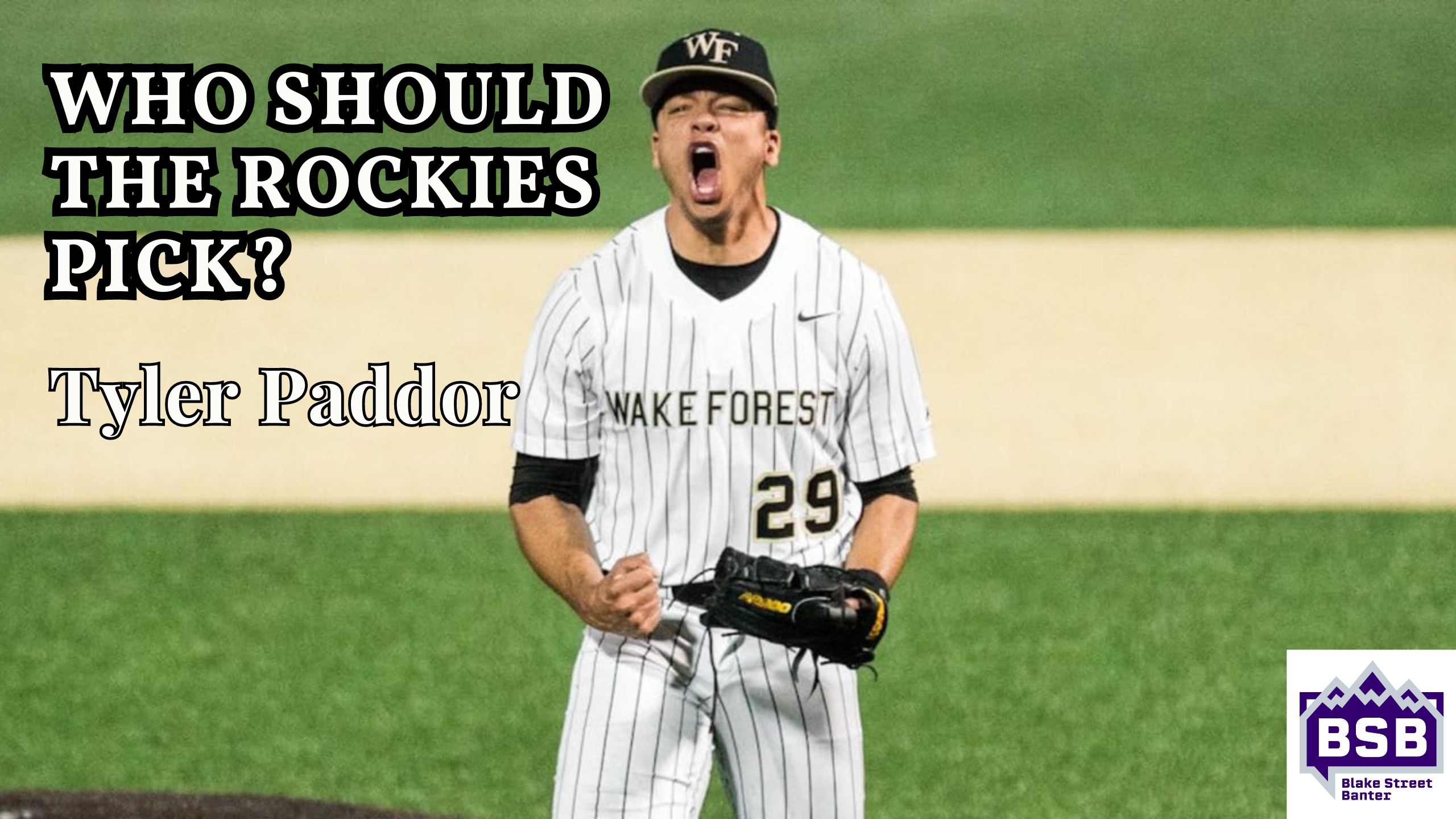
The Rockies hold the number 3 overall pick in this July’s MLB Draft, the source for plenty of Rockies discourse in recent days as the College World Series gets set to crown college baseball’s next national champion.
Table of Contents
Understanding the Process
Options for the Rockies are vast and the fanbase’s consensus has jumped around substantially. Much of the year, Wake Forest’s Chase Burns has been the guy. Then Arkansas lefty Hagen Smith entered the picture. Now, Florida two-way star Jac Caglianone has captured the attention of Rockies faithful.
This is happening all in the foreground of monumental offensive seasons by new BBCOR home run king Charlie Condon and Oregon State prodigy Travis Bazzana. Other college phenoms like J.J. Wetherholt, Braden Montgomery, and Nick Kurtz simply can’t be ruled out either.
It’s undeniable that the Rockies will always have a greater need for pitching than other clubs because of their difficult home pitching environment. However, the MLB draft is not a need-based process. Even the best prospects are a year or more removed from competing at the game’s highest level and there are substantial risks for top draft picks to reach the big leagues, let alone make an impact there.
For that reason, all options are on the table and the Rockies have never been an organization to make the same type of pick over and over. Across the last 10 drafts, the Rockies–in order–have selected: LHP Kyle Freeland (2014), SS Brendan Rodgers (2015), RHP Riley Pint (2016), LHP Ryan Rolison (2018), 1B Michael Toglia (2019), OF Zac Veen (2020), OF Benny Montgomery (2021), RHP Gabriel Hughes (2022), and RHP Chase Dollander (2023) in the first round. This chronology shows the Rockies tend to draft in a balanced fashion.
Further, when you consider the Rockies haven’t gotten an abundance of big-league success from these picks, it demonstrates the need and pressure to take a player that instills confidence, regardless of position.
All this is to say, don’t rule out a hitter at pick 3 and if the Rockies elect to grab a bat, it’s not a bad decision.
Before we dive into some brief reports, it’s important to note how significant positional value is in the draft. We all know shortstop, center field, and catcher are the most irreplaceable positions on the field; few players can man those spots adequately. Third base, second base, and the corner outfield spots all fall in the same tier as spots that not everyone on a team can play but anyone capable of playing short or center could play their neighboring counterparts.
On the other hand, first base is an extremely replaceable position because there are few athletic limitations on the position; most pro position players could handle first base. Of course, there are nuances to playing first base that you want a first baseman by trade to develop, but it’s not wise to invest a high draft pick into a first baseman unless that player’s bat is just so much better than other options (sorry to anyone clamoring for Jac Caglianone or Nick Kurtz).
Travis Bazzana, 2B, Oregon State
Pros:
- Premium contact hitter
- Elite approach
- Plus power (should consistently rack up 25+ HR per season)
- Quality speed (20+ SB threat)
Cons:
- Limited to 2B presently, could potentially pick up LF in the future
It’s not often a player enters the draft practically ready for the big leagues with limited risk and also a strong chance to be a multi-time All-Star. If Bazzana is available at 3, the Rockies should feel obligated to select him.
Charlie Condon, 3B/OF, Georgia
Pros:
- Rare power (35-40 homer projection)
- Hits a ton of flyballs
- Makes a lot of contact
- Proven defensive versatility
Cons:
- Athletic limitations
- Average plate discipline
- Showed weakness on pitches in the lower bound of the zone
Clearly, Condon should be a premier masher in the pros and a solid pure hitter. While I personally prefer Bazzana for the complete hitting package, you can’t go wrong with Condon, especially after he’s proven capable of manning third base and the outfield corners.
Chase Burns, RHP, Wake Forest
Pros:
- Like a stick of dynamite
- Borderline elite (80 grade) slider
- Promising curveball
- Strikethrower
- Great extension
Cons:
- .998 OPS against fastball
- Command still a work in progress
Burns has been and will continue to be the best option in most people’s eyes. And why not? The Rockies need high upside starters and who better than a guy that averages 97.8 mph on his fastball with a near 80 grade slider.
Jac Caglianone, 1B/LHP, Florida
Pros:
- Special power (could be 45+ homer guy at peak)
- Great contact hitter
- Up to 99 on the mound
- Above average changeup
Cons:
- 37.4% chase rate
- Erratic control on the mound
- Aside from velo and some deception, fastball lacks good traits
Somehow Caglianone one ups Condon in the power department; it’s legit Judge/Stanton power levels and he manages to make a lot of contact. The issue is a chase rate that’s nearly double the ideal mark for a high-round prospect. Without the ability to provide defensively, that’s a legit risk factor on the bat. Additionally, his future on the mound has gotten very murky.
J.J. Wetherholt, SS, West Virginia
Pros:
- Elite combination of bat to ball skills and plate discipline (70 grade hitter)
- Raw power uptick this year
- High end speed (25-30 SB type of guy)
- Able to handle SS, could easily man 3B and 2B
Cons:
- Persistent hamstring injury this year
- More ground balls than other top tier hitters
Wetherholt was a near unanimous favorite for the number 1 pick before the season started and for good reason. He’s not talked as often in that spot now because of a hamstring injury that cost him a good portion of the season. I present this with no comment (he’s clearly in the same tier as Condon & Bazzana):
| Condon | Bazzana | Wetherholt | |
| 90th% EV | 111.8 mph | 108.7 mph | 107.9 mph |
| Chase% | 22.5% | 14.3% | 14.3% |
| Zone Contact% | 89.0% | 88.2% | 88.5% |
Hagen Smith, LHP, Arkansas
Pros:
- Rare left-handed power (94-98 mph, T100)
- 70-grade slider; lefties do not stand a chance
- Deceptive and funky
- Budding changeup
- Above average extension and lower arm slot
Cons:
- Minor questions surrounding control
- Mostly two-pitch pitcher at the moment
Arguably, Smith carries fewer question marks into the pros than Burns. His fastball is certain to be effective in the pros and his slider will immediately be one of the better breaking balls in the pros. The developing of a third pitch will be key to Smith realizing his potential as a frontend starter.
Braden Montgomery, OF, Texas A&M
Pros:
- Super easy plus power (40+ HR threat)
- 70-grade arm
- Development as hitter profiles him as a 50/55 grade bat
Cons:
- Not polished as right-handed hitter
- Broken ankle creates a smidge of risk
Montgomery is an interesting case because he’s on the same level as Condon and Caglianone as a left-handed hitter but his current commitment to switch-hitting drags his overall production down. There’s quality defensive potential here because of Montgomery’s huge arm and average athleticism but a recent broken ankle will be in teams’ minds as they pick.
Nick Kurtz, 1B, Wake Forest
Pros:
- Best approach in the draft
- Double-plus power (35-40 HR guy)
- Rare ability to elevate the baseball (26.3 GB%)
- Bat to ball skills improved to be above average
Cons:
- First base only
- Vulnerable to outer-half pitching
Matt Olson is a decent comp for Kurtz; he’s all but certain to mash and get on base plenty. The first base restriction is the only thing holding Kurtz back from being a top 3/4 pick lock.
Verdict
The verdict is that there is no verdict. The Rockies have 8 premium prospects in their sights right now and will get their choice of at least 6 of them and could hardly go wrong with any of them.
The MLB Draft is known for having unlimited factors in play at all times, making it extremely unpredictable. Stay tuned as the dust begins to settle on the amateur season.
Written by Ty Paddor.
ICYMI: Prospect Profile: Andy Perez.
Brought to you by…

Leave a Reply