
After a miserable season at the MLB level that saw the Rockies lose a franchise record 103 games, the focus has been on, and will continue to be on, 2024 and beyond. The most critical piece of the future is how the Rockies farm system pans out.
The consensus from pundits seems to place the Rockies roughly middle of the pack. MLB.com ranked them 18th closer to mid-season, as did ESPN. Bleacher Report ranked Colorado 15th at the end of the year and Fangraphs has the Rockies 16th.
It’s important to present the more neutral perspective on the club but we’re all aware of the slight favor larger market teams can receive from national outlets. Additionally, with all of these sources, we see few people try and track the entire leagues’ prospects. Ranking farm systems is an imperfect process, irregardless of who seeks to rank them.
In other words, there is your disclaimer for what is to follow in this article. There won’t be farm system rankings here but we need to have a conversation about where the Rockies stand and what usually constitutes a quality system.
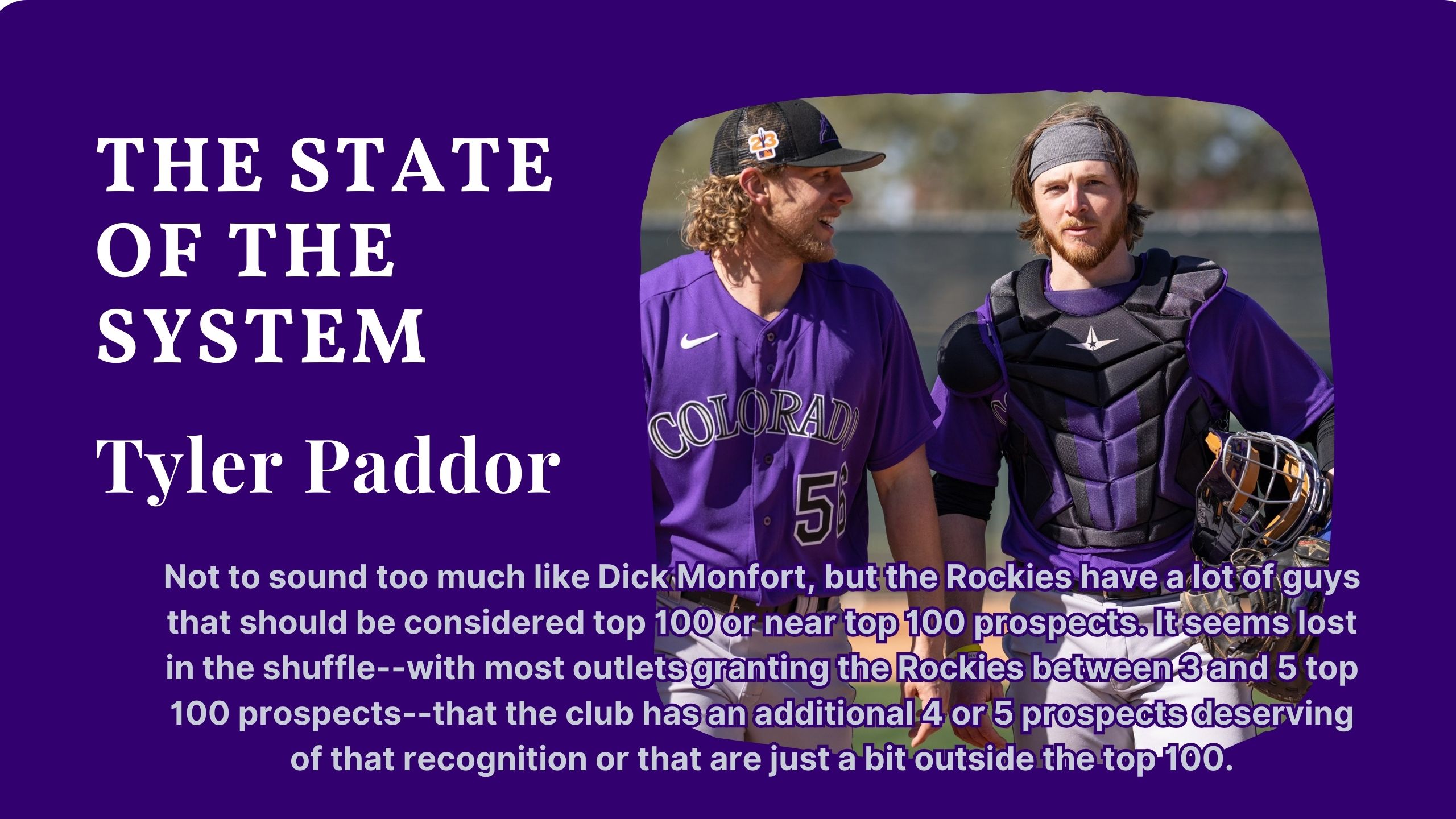
Not to sound too much like Dick Monfort, but the Rockies have a lot of guys that should be considered top 100 or near top 100 prospects. It seems lost in the shuffle–with most outlets granting the Rockies between 3 and 5 top 100 prospects–that the club has an additional 4 or 5 prospects deserving of that recognition or that are just a bit outside the top 100.
With the groundwork laid, let’s break the Rockies system into tiers. For what is to follow, the rankings will approximately follow Tyler’s (@TyPaddor on Twitter/X) rankings which can be found here.
Tier 1: Top 25 Prospects in MLB
1 Adael Amador – 69 G, .287/.380/.495 (134 wRC+), 39 BB/37 K, 12 HR, 15 SB
Amador sits alone in this tier. No one else in the system pairs his floor–a high-end utility infielder, if not a capable everyday player–with his ceiling–a switch-hitting, top-tier on-base threat with speed, 20 home run power, and potentially plus 2B defense.
Amador’s rankings are somewhat variable between different scouting outlets with a high of 8 from Fangraphs and rankings of 13 and 21 from ESPN and MLB.com, respectively. Clearly, he’s a top 20 prospect by all accounts and there’s a case he’s top 15 or even top 10.
Tier 2: Top 75 Prospects in MLB
2 Zac Veen – 46 G, .209/.303/.308 (72 wRC+), 23 BB/43 K, 2 HR, 22 SB
3 Chase Dollander – Did not make pro debut
This may not be the most agreeable pairing to have as the Rockies 2 and 3 prospects, but Zac Veen was a consensus top 50 prospect and arguably top 25 before his wrist injury sometime in 2022. About a half season of injured baseball between late-2022 and early-2023 in Double-A as a 21-year-old shouldn’t move the needle much.
Chase Dollander enters pro ball with a promising profile. Not many pitchers join the pro ranks with mid-90s velocity, three secondary pitches, and a reputation for great command, based on his 2022 season at Tennessee. He’s one of a select group of pitching prospects that truly project to be #2/#3 starters; the mid-rotation tag gets thrown around way too often.
Tier 3: Top 100/125 Prospects in MLB
4 Jordan Beck – 126 G, .271/.364/.503 (134 wRC+), 73 BB/142 K, 25 HR, 20 SB
5 Benny Montgomery – 109 G, .251/.336/.370 (95 wRC+), 52 BB/135 K, 10 HR, 18 SB
6 Drew Romo – 95 G, .259/.317/.445 (104 wRC+), 29 BB/71 K, 13 HR, 6 SB
7 Sterlin Thompson – 94 G, .293/.376/.487 (134 wRC+), 38 BB/74 K, 14 HR, 17 SB
8 Yanquiel Fernandez – 117 G, .265/.313/.486 (110 wRC+), 32 BB/132 K, 25 HR
Here’s where the real dilemma is. These five prospects are all roughly top 100 prospects. With the exception of Sterlin Thompson, all five have appeared in MLB.com’s top 100 at some point and Thompson is all but certain to crack their next updated list.
Jordan Beck is a 5-tool outfielder with immense upside. He maintained a quality OBP in Double-A after his promotion. His power is as big as anyone in the system, his bat is more advanced than he was given credit for, and he’s an above-average runner and defender with a cannon for an arm.
Benny Montgomery’s name has been left behind in Rockies top prospect discussions lately. However, as Baseball America noted in a recent article, Benny Montgomery had the single-best improvement in his chase rate from last year to this year among MiLB players. He followed that up with a torrid Arizona Fall League performance. Montgomery’s triple slash line of .343/.447/.486 (.933 OPS; 11th in the AZFL) stands out along with his two home runs and nine stolen bases. With tools up the wazoo, a performance like this has reignited Montgomery’s prospect stock.
Drew Romo has also been somewhat left out of Rockies top prospect conversations, after a slow start as a 21-year-old in Double-A. Romo finished with an above average line in Double-A, en route to a Triple-A promotion. He’s still an advanced defender behind the plate with a great arm and belongs firmly in top 100 conversations.
Sterlin Thompson is currently wrapping up a heck-of-a year in the Arizona Fall League. The Trevor Story comp pick recorded a wRC+ of 134 this season with 14 home runs and 17 steals in just 94 games. He then took to the Fall League and now ranks 5th in OBP and 10th in OPS. Thompson’s now recognized advanced bat and prodigious season will almost surely get him on top 100 lists going into next year.
Finally, Yanquiel Fernandez is as good as any player in this tier. This is a good time to remind everyone that these five prospects could be ranked in any order and Fernandez could very well be viewed as the best of the group. The 20-year-old hit 25 home runs this year, though he was slowed down in Double-A. His 32.9 K% at the level should be viewed as a blip on the radar; Fernandez has never had swing-and-miss issues and will adjust to better pitching. His power is very impressive and until Double-A, his bat-to-ball skills were above-average, as well.
Can/should all five be considered top 100 prospects? The answer isn’t yes or no. All five have a strong case as top 100 prospects, in their own right. The reality is, a rigid top 100 has limited spots and none of the five are no brainer picks for a top 100 list; there’s usually 125 or more guys worthy of being considered top 100.
That raises the greater point; all five of these players are top 100 quality, giving the Rockies 8 prospects that could be considered top 100 prospects.
From here, if you want to get to the crux of the topic–how we should be viewing the Rockies farm system–feel free to skip to the bottom (“Tying Things Together” heading).
Tier 4: Outside the Top 125
10 Jordy Vargas
Ironically, this tier is smaller than tier 3. The reason being that these four could conceivably be pushed into top 100 consideration in such a way that prospects to follow can’t quite be.
Hughes has power stuff, a great frame, and quality enough control to be considered a top 100 candidate in the future. Vargas has big time stuff and quality command right now with a ton of projectability. Vargas has also received top 100 love before from Fangraphs in the past. These two might have been higher had their seasons not been cut short upon needing Tommy John surgery.
Sean Sullivan could be placed above both Hughes and Vargas. He’s got such a clean profile and could very well find himself on 2024 midseason top 100s, should be hit the ground running next season.
Finally, we all know what Hunter Goodman–a.k.a. Your Mom’s Favorite Player–is all about after seeing him debut at the MLB level. He leads MiLB in home runs since the start of 2022, making him one of the most premier power hitters among MLB prospects. If his defensive future was more clear, top 100 consideration would not be out of the question.
Tier 5: Top ~300 Prospects in MLB
13 Jake Madden
14 Robert Calaz
15 Joe Rock
16 Dyan Jorge
18 Ryan Ritter
This tier isn’t very big either but that’s because the overall prospect pool still isn’t that large. I made sure to include the approximate symbol in front of the 300 because it’s hard to fathom 17 prospects inside the top 300, although it certainly appears fair.
All five of these players bring some kind of standout carrying tool or blend of quality tools. Madden has a huge projectable frame with present power stuff. Calaz is athletic with big power and showed a proclivity to hit in his pro debut. Rock has a big frame, deception, and three quality pitches. Jorge is very athletic and has a good feel for hitting. Palmquist has solid command of three average or better pitches. Finally, Ritter is an MLB-caliber SS defender with above-average power.
Tier 6: Top 500 Prospects in MLB
20 Jaden Hill
21 McCade Brown
22 Jackson Cox
25 Cole Carrigg
This groups centers on upside. Bernabel has excellent hands at the plate and could make an MLB impact this season. Hill has arguably the best stuff in the system but is working to find consistency. Brown missed all of 2023 but was one of the organization’s best pitchers in 2022.
Cox has elite arm talent and flashed serious upside before he joined the slew of Rockies prospects getting Tommy John. Williams flashes legit mid-rotation ability and sits 3rd in the Arizona Fall League for ERA among pitchers with 14 innings.
Albright, acquired in the Randal Grichuk & C.J. Cron trade, has a great feel for pitching and solid stuff. Finally, Carrigg brings a unique and compelling skillset with plus speed, a huge arm, great contact skills, and the ability to play all four up the middle positions (SS, 2B, CF, & C).
For these players to make up the late-teens/early-twenties in this system speaks to the depth the Rockies are currently working with.
Tier 7: Could Break Into Top 500
27 Jack Mahoney
30 Ryan Rolison
I’ll hold off on more analysis as this article has already gotten lengthy. However, the bulk of this tier is comprised of high-upside pitching talent. The odds one of Coupet, Mahoney, Prosecky, Weatherly, or Rolison put it together as a legit MLB starter is high.
The rest of the Rockies rankings list can be found on Tyler’s ranking sheet. These are not official rankings and arguments can be made for most guys to be in different spots than they’re ranked here.
Tying Things Together
That was a lot of words to lead to a final conclusion; the Rockies farm system appears underrated in national circles. Are they in MLB’s top tier for prospect pipelines? Not quite, but it’s hard not to give them the benefit of being a top 10 system right now.
How many systems have 8 prospects who could (and maybe should) be considered top 100 prospects? A handful at most. The depth of the Rockies system also goes head to head with most systems in baseball.
Does this mean the Rockies will for sure get a huge talent influx in the next two seasons? Kind of. Prospects are never certain but it’s hard to imagine the Rockies don’t get a small handful of impact everyday players from the top half of their system.
If you’ve really followed along with the Rockies in recent years, even back in late 2010s, depth has been a massive issue. Even when the Rockies have been decent (75+ wins), they’re very top heavy and don’t bring a good supporting cast.
On the flip side, if the Rockies want to bolster their MLB roster for now and the short-term future, they’re in a position to package some prospects (maybe with one of their young MLB players) and make a trade for a controllable MLB player.
Either way, the Rockies farm is good. Is their MLB roster in dire straits and in need of a talent boost? Absolutely, but the farm system should not be lumped in with a meager MLB situation right now.


Leave a Reply