
Tyler Paddor | @RoxDontRake | July 3, 2023
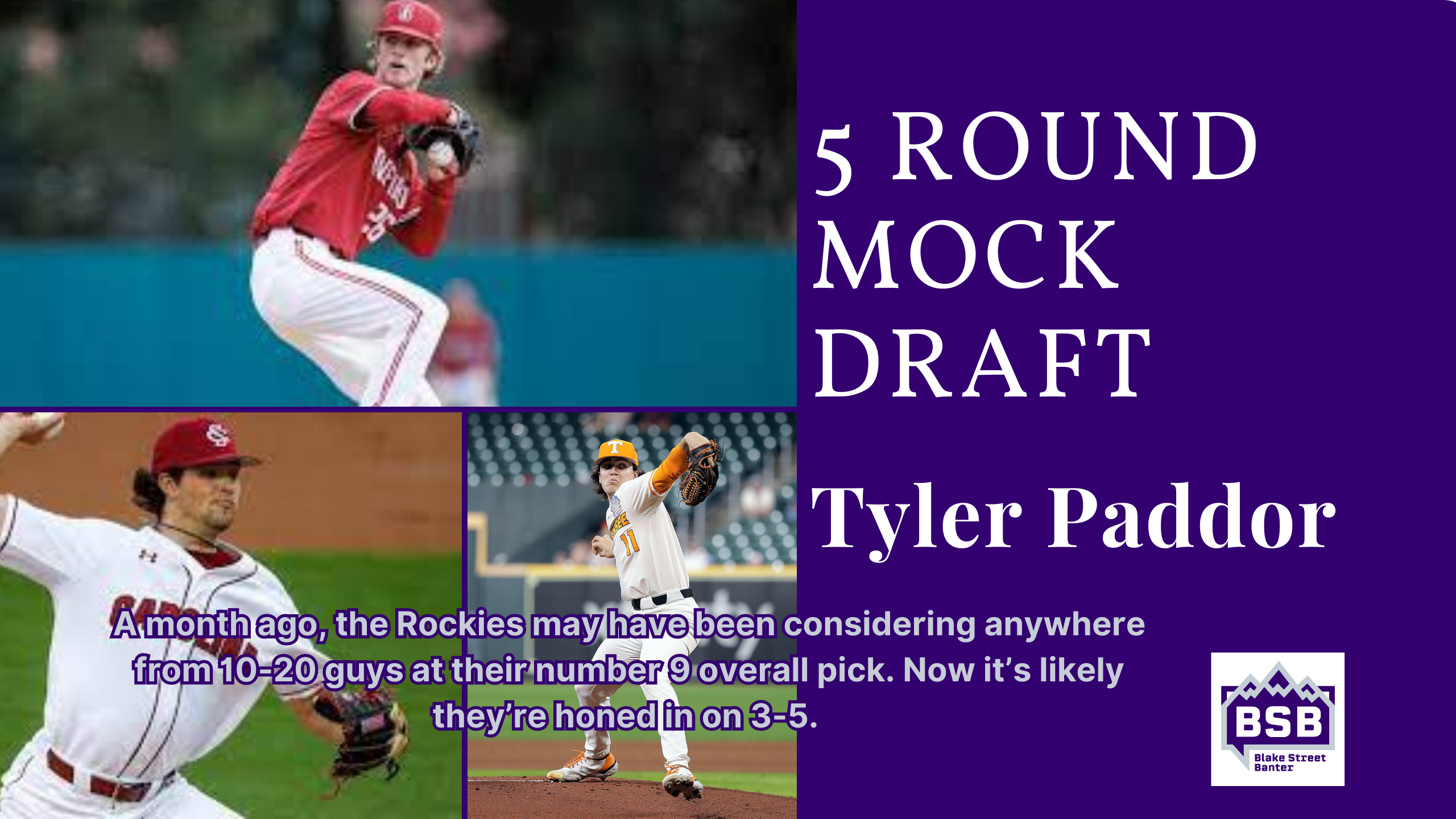
The draft is less than a week away and behind the scenes, the first dominos are beginning to fall. A month ago, the Rockies may have been considering anywhere from 10-20 guys at their number 9 overall pick. Now it’s likely they’re honed in on 3-5. I can’t act like I know who those guys are exactly although we do know they have a lot of interest in the college pitching with Chase Dollander and Rhett Lowder serious options.
In this mock, using Prospects Live’s mock draft simulator, I’ll try and find a balance between the Rockies draft philosophy and how I would approach each selection.
In this simulation, the first 8 picks went as so: Dylan Crews, Paul Skenes, Wyatt Langford, Walker Jenkins, Max Clark, Noble Meyer, Rhett Lowder, and Arjun Nimmala, leaving the Rockies to take:
(R1) Pick 9: Chase Dollander, RHP, Tennessee
For this pick, I strongly favored what I think the Rockies will actually do over what I see as the best move. While Dollander came into the season as a candidate to go first overall, his stuff didn’t take a step forward while his command regressed.
On the season, Dollander posted a 4.75 ERA with 120 strikeouts and 30 walks in 89 innings.
We covered Dollander in our preview of college pitching and I ranked him 4th among Paul Skenes, Hurston Waldrep, and Rhett Lowder. That isn’t to say he’s all of a sudden become undesirable but he left something to be desired this season and I would much prefer one of the abundant college bats like Kyle Teel, Tommy Troy, Enrique Bradfield Jr, Brayden Taylor, Matt Shaw, or Chase Davis–take your pick.
Still, Dollander has top of the rotation upside. He’s got a plus–maybe double-plus–fastball in the mid 90s that garnered a 30% whiff rate and features some run and can carry up in the zone. He’s also capable of throwing it downhill, which is where the Rockies would have him throw it more often than other organizations.
Dollander’s slider also has plus characteristics with more of a sweeper profile in the upper 80s, though it got crushed this year to the tune of a .914 OPS. The Georgia Southern transfer did not locate the pitch overly well, leaving it center-cut far too often.
There is some upside to be unlocked with further use of Dollander’s upper 80s changeup that he throws with deceptive arm action. There’s also a curveball in Dollander’s arsenal with pretty loopy shape in the mid 70s that could serve as a true change of pace from his upper 80s secondaries.
I may begrudge the pick slightly but Dollander has the upside to be the best pitcher in the draft and a top of the rotation arm. There is risk with his spotty in zone command and lack of a definite second go-to pitch but with some pro coaching, Dollander’s best days could be ahead.
In terms of slot value, Dollander may command close to the Rockies full slot after going into the season with hopes of going top 5. There’s a real chance though that his bonus demands are closer to $5.5 million with his draft floor seemingly in the teens. If the Rockies were able to sign Dollander for that amount and shave about $200k off their $5.71 million slot at pick 9, it could serve them well as they make their two other top 70 picks.
Next two up at 9: Hurston Waldrep, RHP, Florida; Chase Davis, OF, Arizona
Waldrep is my SP2 in the draft. He’s got a ridiculous split-change, two high quality breaking balls and mid-90s velocity. His fastball has not performed, allowing a 1.020 OPS against it this year, pushing him down the board from being a certain top-10 pick.
Davis is my favorite offensive prospect in this draft aside from Dylan Crews and Wyatt Langford. It’s easy plus power, a picturesque Carlos Gonzalez-like swing, much improved plate discipline, and the athleticism to potentially handle CF.
Either of these players would be fantastic selections but the real excitement at 9 lies in the endless possibilities to those on the outside of the draft room. Keep an eye on prep players like two-way Bryce Eldridge, right-hander Noble Meyer, and shortstop Arjun Nimmala should they hang on the board.
(R2) Pick 46: Cooper Pratt, SS, Magnolia Heights (MS)
Prep hitters are always enticing. Looking around MLB, most of the top American hitters were selected out of high school. There is typically more risk involved than drafting a college hitter but the upside is far greater with the average prep prospect.
Pratt is no different, offering a unique blend of floor and ceiling. The Mississippi high-schooler stands 6’5″ and around 205 pounds.
Pratt’s biggest selling point is his pure hitting ability. He already deploys a mature approach with impressive feel for the strike zone. Pratt has quiet hands and a smooth swing path that helps him make a lot of contact. His hands also pack a punch with their quickness. Without a doubt, he’ll hit in the pros.
Currently, Pratt is not a masher. His power is roughly average now but the hope is for above-average power with more physical development and to emerge as a 20-25 home run threat.
Pratt mans shortstop as an amateur and has the hands and feet to stick there long term although he’s not a plus runner and will likely only lose range as he fills out. Worst case, Pratt profiles as an adept 3B or 2B with the corner outfield also a possibility where his plus arm could be an asset.
I’d love for the Rockies to add another high upside bat somewhere in this draft and capitalizing on an unusually deep SS prep class seems like the best way to do it.
High-end prep players drafted outside of round 1 rarely accept slot value. In this case, the Rockies pick is slotted at $1.86 million. If they can save some with their first round pick, they can offer someone like Pratt a touch over $2 million.
There is serious potential here as a long-time .350 OBP type of hitter with power. Gotta take chances on guys like Pratt.
Next two up: Colton Ledbetter, OF, Mississippi State; Juaron Watts-Brown, RHP, Oklahoma State
Ledbetter will likely go in the first round because of a quality blend of bat-to-ball skills and raw power along with center field capability. I was planning to write him in here but was swayed by the idea of a prep player. Ledbetter walked 47 times and struck out just 36 times this year to go along with 12 home runs.
Watts-Brown has an explosive arm, sitting mid-90s with a Houdini disappearing slider and quality curveball. He didn’t perform as hoped this year with a 5.03 ERA and too many walks but the stuff is amazing.
With prep shortstops in mind, keep an eye on Colin Houck, Colt Emerson, Kevin McGonigle, Walker Martin, George Lombard Jr, Sammy Stafura, Adrian Santana, Roch Cholowsky and a handful more who all stand as candidates to be selected in the top 50.
(2 CBB) Pick 65: Kiefer Lord, RHP, Washington
Spoiler alert, the Rockies are going to draft a lot of pitching. They always have, always will, and will especially focus on that side of the ball in the current times of panic.
Enter Kiefer Lord who just over a year ago was pitching for Division III Carleton College in Minnesota. He posted a 1.65 ERA with 81 strikeouts and just 7 walks across 49 innings there before getting a shot in the Pac-12.
The Slender Lord (nickname rating? @Evan Lang) made a huge impression, getting day 2 draft hype after just a couple starts. His fastball averaged 94 on the year and routinely touched 98; all while still standing 6’3″, 195 lbs.
It’s a very whippy arm that has teams banking on consistent upper 90s velo once Lord adds more strength. The fastball carries up in the zone; a trait 29 teams in MLB clamor for but not as much the Rockies who prefer 2-seam movement. Still, the Rockies have to be seeking diversity within their pitching archetypes.
He backs it up with plenty of strike throwing and two breaking balls, both of which could be above average. The wheels came off on Lord down the stretch–giving up 27 of his 52 earned runs in his last 4 starts–which can be expected after making a DIII to DI rotation jump. So don’t let the 6.19 ERA fool you.
There is a ton of upside with Lord as a late bloomer with plenty of projection remaining. He already knows how to pitch and just needs refinement. I think Lord will be a popular underslot candidate for team’s early in the second.
Next two up: Will Sanders, RHP, South Carolina &; Ty Floyd, RHP, LSU
I’ll save my insight on Sanders for below.
Coming off a 17-strikeout College World Series performance against Florida, Ty Floyd likely worked himself into the top 50 which factored into my decision to take Lord. Floyd brings a plus mid-90s fastball and three average or better secondaries with his changeup flashing plus this year.
(R3) Pick 77: Will Sanders, RHP, South Carolina
Sanders stayed on the board after I came close to slotting him in at 65. The 6’6″ hurler garnered first round hype coming into the season but his 5.46 ERA on the year might drop him out of the top 50.
Looking at the pure stuff, it’s a smoke show with Sanders. He sits 92-95 and gets run on his fastball, though you can make a case that is his weakest pitch.
Sanders’s slider ranges in the mid-80s and features late two-plane break that, when located, is unhittable. His slider notched a jaw-dropping 60% whiff rate and enters pro ball as a clear plus pitch.
Sanders also throws a mean mid-80s curveball that can’t be hit down in and below the zone. Finally, his upper-80s changeup can bend air, getting huge armside run and fading down in the zone.
Overall, it is ace caliber stuff and he keeps walks in check. A few too many home runs allowed on mistake pitches are the reason for undesirable production. There is real reliever risk because of the spotty command but if everything came together for Sanders, he could be a number 2 starter.
Next two up: Joe Whitman, LHP, Kent State; Homer Bush, CF, Grand Canyon
Whitman is an uncommon mid-90s lefty, sitting 92-95. He also features a quality slider and changeup. As a result, he’ll likely end up going in the top 50.
For the Rockies, you can never have enough quality center field roamers. Bush has excellent speed and profiles as an above average hitter. He won’t hit for much power but the floor is ideal.
(R4) Pick 109: Ethan O’Donnell, OF, Virginia
O’Donnell is a Colorado kid from Regis Jesuit and we know the Rockies give local kids a long look.
Fortunately, his game far transcends the Colorado-favoritism and makes him worthy of a top 100 pick. O’Donnell swings a powerful bat with a .587 slugging percentage this year and 13 homers.
O’Donnell is a little aggressive and has some swing and miss to his game but when he makes contact, it is usually hit well.
O’Donnell has been Virginia’s everyday CF and has looked very impressive at times. He isn’t a plus runner so there’s a chance his future lies in a corner but he’ll have a chance to stay up the middle.
There is upside here if O’Donnell can improve his selectivity or find wood a little more often. It’s an athletic OF profile with average power and a feel for finding his barrel.
Next two up: Nick Maldonado, RHP, Vanderbilt; George Klassen, RHP, Minnesota
Maldonado is on the older end for the draft at 23 but the stuff is excellent and he profiles as a mid day 2 underslot reliever.
Klassen actually has some of the best stuff in college baseball, featuring an upper 90s fastball with run and two mid-80s breaking balls with tons of movement. Unfortunately, he walked 47 in 59 innings and faces an uphill battle to be an effective pro. Guys with Klassen’s arm talent do not grow on trees.
(R5) Pick 145: Quinn Mathews, LHP, Stanford
With the final pick in our 5-round mock, the cherry on top is a lefty with pitchability. Mathews also has good stuff to back it up. Guys with his pitching quality are typically going to be in demand within the top 100 but his draft value takes a small hit due to his impending 23rd birthday in October.
The Stanford ace sits 90-93 with his fastball but locates it well. Additionally, his still skinny frame might allow him to grow and sit a tick higher in the pros.
The real sell with Mathews is a changeup that just freezes on hitters. The arm action resembles his fastball but then the pitch falls off the table 10 mph below his fastball. It will produce in the pros.
Mathews mixes a very quality slider in as well and should be a 3-pitch strike thrower. It’s a perfect back-end profile.
Next two up: Camden Minacci, RHP, Wake Forest; Case Matter, RHP, Washington
Minacci was nails in the Wake Forest pen this year, gassing it up to 99 with a plus heater. His slider is also a quality offering.
Matter, another reliever, struggled with command this year but sits mid-90s with two wicked breaking balls.
Wrap-Up
That concludes this 5-round mock. If we manage to hit on even one of these picks, that would be a win.
As mentioned above, expect a lot of pitching. I personally think the Rockies need multiple high-end bats that project as above average everyday players but it is a wise draft strategy to end up taking 13-15 pitchers
July 9th-11th will be a fun couple of days so stay tuned for our extensive coverage of the selections.
Also, let us know who you want the Rockies to take!
Leave a Reply