
Another draft has come and gone with the Rockies holding true to their typical draft methods; target college players and prioritize pitching.
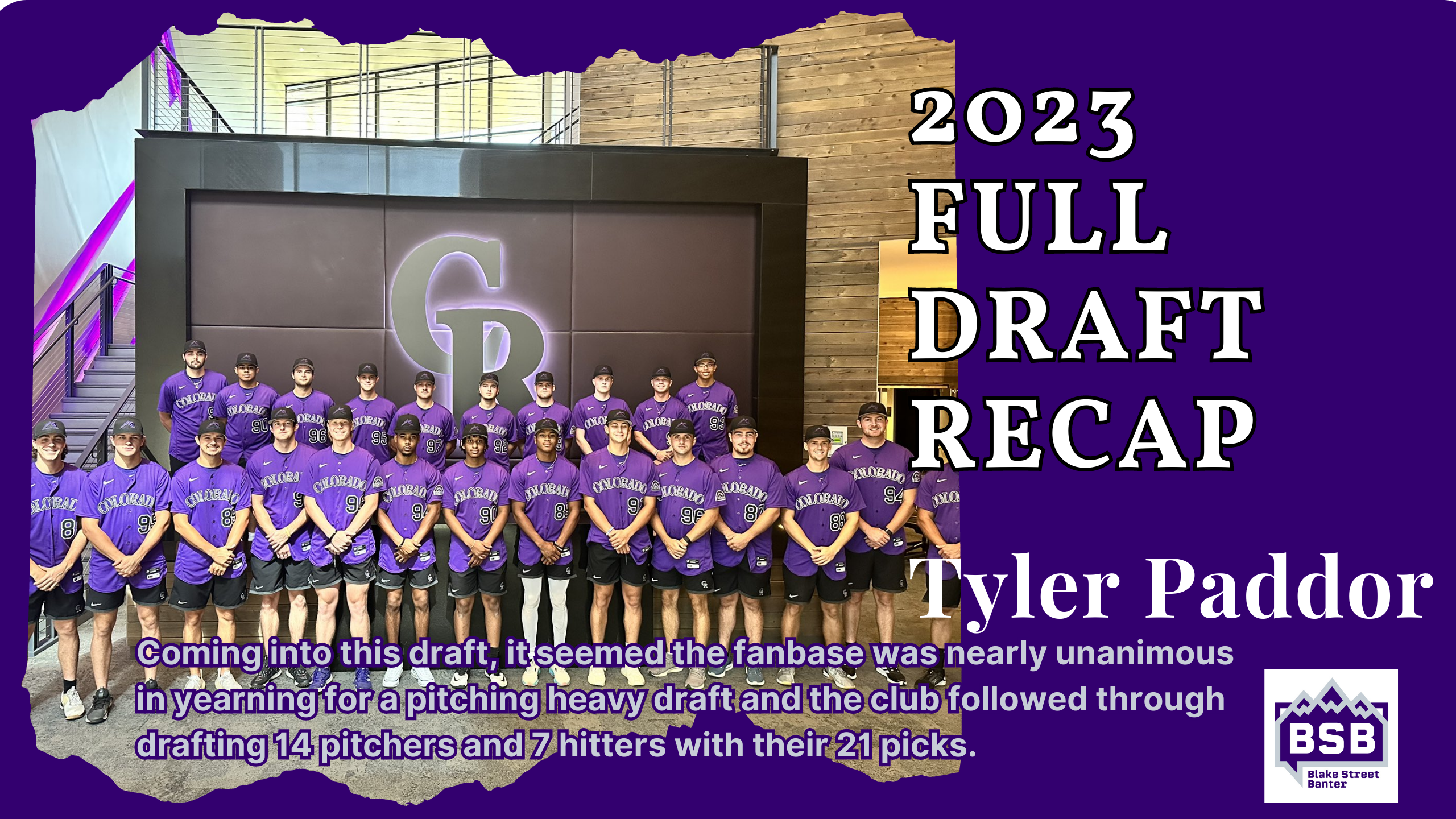
Coming into this draft, it seemed the fanbase was nearly unanimous in yearning for a pitching heavy draft and the club followed through drafting 14 pitchers and 7 hitters with their 21 picks.
Today, we’ll give a primer on every draft pick, expanding on our live-tweet storm, including a fair number of more advanced stats and where the top 4 picks fall in line on my Rockies prospect board. You can check the rest out by clicking here.
Day 1
1st Round: Chase Dollander, RHP, Tennessee
2023 Stats: 4.75 ERA | 89.0 IP | 120 K : 30 BB | 1.27 WHIP
Dollander was one of the few Rockies draft picks in history that everyone from other teams, draft pundits, beat reporters, and fans alike could predict. Several mock drafts projected Dollander to the Rockies and fans were hoping that scenario would come true.
So it came as no shock the Tennessee ace became the next Rockies hopeful impact starter.
The biggest note to make at the beginning is how dominant Dollander was in 2022 with a 2.39 ERA and just 13 walks in 79 IP. Purely based on his 2023 showing, he was a first round pick but Dollander would not have been the Rockies selection had his 2022 performance resembled what we saw this year.
What Dollander Brings
You can’t bring up Dollander without mentioning his double-plus fastball. It’s an electric offering that sits 94-96, topping at 98. I am a fan of its versatility; Dollander can throw it with carry up in the zone but also send it downhill with some run lower in the zone.
The fastball held batters to a .664 OPS and gathered a whiff on 30% of swings, a top tier fastball whiff%.
Dollander supports his fastball with an upper 80s slider, though hitters were all over its inconsistent break this year. He also throws an upper 80s changeup that flashes potential and a change of pace mid-70s curveball.
Dollander’s changeup and curveball usage combined for just 14% of his offerings, despite both pitches getting results and having compelling shape. I’m sure as he enters pro-ball, there will be an emphasis on making those true third and fourth offerings, instead of mere surprise pitches.
In 2022, Dollander’s command was pristine. Matching high-quality stuff with that kind of command was a recipe for domination.
Where Dollander Goes From Here
In terms of what changed this year, there are some mechanical differences from 2022 to 2023. In his current/recent delivery, Dollander appears slightly more leaned forward towards 3B and when he raises his plant leg to start his delivery, it ends up swinging more toward his back knee.
He also included a somewhat more exaggerated glove-arm swing in his delivery. Overall, it looks like Dollander tried to torque his body more and create more momentum with his body through his delivery. However, the largely golden rule of pitching is you want to reduce excessive movement as it can swing off balance and consistency.
Essentially, Dollander tried to create more velocity, which he confirmed in his interview with Thomas Harding, but it came at the cost of the precision that made his sophomore year so impressive. Not to mention, Dollander’s fastball average velocity was the exact same year to year, he just gained a tick on his slider and changeup.
If the Rockies can get his delivery back to the more simple and clean version that featured a standard leg raise, a straighter back, and less of a glove swing, he might be able to find his above-average command again.
For now, Dollander has slotted into the #3 spot on my Rockies prospect board only behind Adael Amador and Zac Veen. If he were to pitch down the stretch this year and impress, a move to #2 is not out of the question.
2nd Round: Sean Sullivan, LHP, Wake Forest
2023 Stats: 2.45 ERA | 69.2 IP | 111 K : 21 BB | 0.92 WHIP
Unlike the first pick, Sullivan was not a name we expected to hear called at pick 46. MLB.com ranked him 123rd, Perfect Game 120th, Prep Baseball Report 70th, and Future Stars Series 71st.
That isn’t to say the pick was unwise. In fact, Sullivan looks underrated. He’s a funky lefty that struck out a ridiculous 39.8% of batters while limiting his walk rate to just 7.5%–both elite marks.
Sullivan started 10 games this year and made long relief appearances in his other 7 outings. He’ll get a serious chance to start in the pros but the fallback option of being a multi-inning reliever gives the former Wake Forest southpaw an exceptionally high floor.
What Sullivan Brings
Sullivan is a low-90s lefty coming from a sidearm slot. He’s been up to 95 and from the slow slot, his fastball can get carry and beat hitters up in the zone. It garnered an elite 36% whiff rate.
Sullivan has a big frame and some projectability left. It’s not crazy to think he may end up sitting 92-94 instead of the current 89-92 which could make his fastball absolutely killer.
Sullivan also dishes out a fading changeup that he locates extremely well just about 7 mph below his fastball. This pitch is primarily thrown to right-handed bats. It garners a 41% whiff rate.
Finally, Sullivan uses a slider to wipe out left-handed hitters. It gets a ton of horizontal break but also has some tilt and drops on hitters a bit, too. The slider pulled a 48% whiff rate.
He’s somewhat limited in that he’s primarily a two-pitch guy to each hitter side but Sullivan has every tool for success; deception, a different look for hitters, adequate velo, great fastball traits, and two nasty secondary pitches.
For now, Sullivan has slid into the 11th spot on my Rockies prospect board, just behind Jordy Vargas and one spot ahead of Jaden Hill.
Competitve Balance Round B (65th overall): Cole Carrigg, C/CF, San Diego State
2023 Stats: .303/.357/.458 (.815 OPS) | 2 HR | 17 SB | 9 BB : 22 K
An unorthodox pick, the Rockies selected Carrigg as a catcher despite being San Diego State’s full-time center-fielder this year. Apparently, Carrigg has always wanted to catch and perhaps he’ll be a great fit there.
The switch-hitting Carrigg dealt with a shoulder injury this year that limited his overall production, though his overall numbers turned out fine, though more production in the hitter-friendly Mountain West Conference would have been ideal.
What Carrigg Brings
The name of Carrigg’s game is athleticism. He’s very fast, nimble, and has a frame capable of generating a lot of strength. He brings 65/70 grade speed to the park which sets him up as an above-average center-fielder.
However, both Carrigg and the Rockies have hopes he can develop into a catcher. The versatile Carrigg does possess a 65/70 grade arm as well that can be an asset behind the plate, though his experience there is limited.
On the offensive side of things, Carrigg has excellent bat to ball skills. Between his healthy 2022 and then 2023, Carrigg’s overall whiff rate was just 17% and his zone whiff rate of 9% is well above average.
The catch is Carrigg free swings, hence why he walked just 21 times over the last two seasons, limiting his upside and presenting risk that his contact quality may be reduced and that he’ll never post above-average on-base rates in the pros.
While his power production has been limited in college–just 7 home runs in 547 PAs–Carrigg has a strong frame with a little room to grow plus data from his high school days that indicates potentially average power.
At a Perfect Game event in 2019, Carrigg’s max exit velocity reached 97 mph, good for the 98th percentile in the 2020 high school class.
Will Carrigg emerge as a power threat? Unlikely but the possibility of double-digit homers isn’t out of the question.
Putting it all together, there is potential for Carrigg to hit for average, steal bases, and provide immense defensive value wherever he ultimately plays.
With more uncertainty surrounding his game, Carrigg slots at 25 on my Rockies prospect board, ahead of Julio Carreras and behind Ryan Rolison.
Day 2
3rd Round: Jack Mahoney, RHP, South Carolina
2023 Stats: 4.16 ERA | 84.1 IP | 84 K : 29 BB | 1.36 WHIP
Mahoney throws mid-90s with a solid four pitch mix. He also comes with uncommon upside for a junior draftee after missing 2022 recovering from Tommy John. Mahoney got very limited reps in college and may still have a lot of developing to do, despite quality collegiate numbers.
The South Carolina starter averaged 93.5 on his fastball this year with a slightly below average 16% whiff rate. His slider and changeup are both average or better secondary pitches, with a curveball also in his back pocket needing some refinement.
Mahoney’s slider averaged 84.6 and picked up a 34% whiff rate while his changeup averaged 84.4 with a stellar 46% whiff rate.
Again, there’s some upside here. Mahoney likely fits the typical backend starter mold but if his stuff can take a step forward, a mid-rotation profile is not out of the question.
For now, Mahoney checks in at 29 on my board.
4th Round: Isaiah Coupet, LHP, Ohio State
2023 Stats: 3.55 ERA | 50.2 IP | 72 K : 16 BB | 1.12 WHIP
Coupet was one of my favorite picks from the entire draft. He isn’t imposing on the mound, probably a tick below 6’1″ with a smaller build but he knows how to pitch and he can spin a baseball with the best of them.
Coupet doesn’t touch mid-90s often, averaging 90.2 mph and topping at 94 but he lives in the zone with a quick and deceptive arm. That quick arm is responsible for two of the best breaking balls in the entire 2023 class.
Coupet’s slider is a true demon pitch, featuring massive two-plane break and soaking up whiffs on 56% of swings–one of the best marks you’ll see from any college arm. He backs that up with a more vertical curveball that recorded a 52% whiff rate.
Finally, Coupet’s changeup is potentially a plus offering. His arm action masks the pitch as his fastball and there’s just about 6 mph of velocity difference. The pitch also features heavy fade and drop.
All in all, it’s three really good secondary pitches from Coupet with quality command. His fastball got hit a lot this year but not as much down in the zone where its downhill shape induced a lot of weak contact. Coupet’s upside isn’t massive due to a lack of overall strength but I see a potential back-end starter.
5th Round: Kyle Karros, 3B, UCLA
2023 Stats: .284/.372/.420 (.792) | 5 HR | 3 SB | 22 BB : 35 K
The son of long-time Dodgers first baseman, Kyle Karros will now play with a chance to make the Karros name a bittersweet one for Dodgers faithful. Karros dealt with an ankle injury this season and did not get to breakout as many evaluators had hoped.
Fortunately, Karros flashed improved plate discipline and solid bat to ball skills for a player with his kind of raw power. That raw power never flashed in games like it could have but Karros can impact the ball in such a way that indicates 20 homers or more is well within reach.
Hopefully, Karros can get a healthy start to his pro career and show why his bat made him worthy of an even earlier selection.
6th Round: Cade Denton, RHP, Oral Roberts
2023 Stats: 1.83 ERA | 64.0 IP | 86 K : 15 BB | 0.984 WHIP
Denton was purely a reliever at Oral Roberts and was dominant in doing so with a 1.25 ERA over his last two seasons there. He brings a mid-90s fastball that has touched 99 and a nasty low-80s slider that induced a 45% whiff rate.
Denton is working on developing a changeup/splitter that has flashed being above average. If that pitch can come along, Denton will have a chance to start and the upside to develop into a quality big league option out of the rotation.
His frame leaves some room to grow, as well and it would not be shocking if the Summit League Pitcher of the Year eventually sat close to the upper-90s. Worst case, Denton looks like a very safe big league reliever.
7th Round: Seth Halvorsen, RHP, Tennessee
2023 Stats: 3.81 ERA | 52.0 IP | 52 K : 16 BB | 1.058 WHIP
In Halvorsen, the Rockies added another high floor relief prospect.
After transferring to Tennessee, Halvorsen found himself as a key cog in the Vols bullpen. The big right-hander touched 101 this year and averaged 95.7 mph on his fastball. Halvorsen’s second pitch is an upper 80s changeup with good fading action, though it only drew a 27% whiff rate. Halvorsen also throws a quality slider (39% whiff rate).
Strike throwing became one of Halvorsen’s strongest traits this year and given his arm strength, there is a solid future in a bullpen here, though with starting experience in 2022 at Missouri, a chance to start isn’t off the table.
8th Round: Braylen Wimmer, SS/2B, South Carolina
2023 Stats: .304/.409/.562 (.970) | 14 HR | 13 SB | 30 BB : 55 K
Wimmer was an exciting pick for the Rockies. The 6’4” middle infielder brings every tool to the ballpark. He has average or better power, makes a fair amount of contact, can work ABs and won’t be overly aggressive or strikeout-prone, he has average or better speed, and can pick it up the middle, though he’s likely a second baseman long term.
Wimmer would have certainly gone higher in the draft had he been a tad younger–he’ll be 23 in December–and if he profiled at shortstop long term but the Rockies find themselves an up the middle player with a bat that should produce a lot in the early minors. Best case, Wimmer can be an average or better offensive threat at 2B.
9th Round: Ben McCabe, C/1B/OF, UCF
2023 Stats: .371/.466/.692 (1.158 OPS) | 19 HR | 6 SB | 17 BB : 59 K
McCabe raked this year. He now leaves Central Florida after an impressive 5-year career that saw him hit 49 homers backed by a .928 OPS. At 23 and a half years old, there was a knock on his stock but it’s hard to imagine the playable power couldn’t have gotten him drafted a round earlier.
McCabe compares to Hunter Goodman whom the Rockies selected in the 2021 draft. Not only do both players possess aggressive swings and approaches that prioritize crushing baseballs but both profile best off the catching position long-term. McCabe already logged a fair amount of time at 1B and in the corner OF so he will be ready for that transition. McCabe’s arm could make him an asset in the OF.
There are some concerns with his chase and whiff rates but if the power plays, that won’t be much of an issue.
10th Round: Jace Kaminska, RHP, Nebraska
2023 Stats: 4.13 ERA | 72.0 IP | 57 K : 15 BB | 1.139 WHIP
Kaminska looks the part of a back-end starter. I’m not sure the quality of his stuff will make that an easy journey but he certainly checks off pitchability boxes; he throws a lot of strikes and has feel for his deeper arsenal.
Kaminska’s low-90s fastball finds his mark a lot and between his two breaking balls, there is enough bat-missing potential. Where the upside really lies is with Kaminska’s changeup that held batters to just a .456 OPS. If he can find more of an identity with his breaking stuff, Kaminska could carve through the minors and open the door for a swingman/back-end role.
Day 3
11th Round: Stuart “Stu” Flesland III, LHP, Washington
2023 Stats: 4.12 ERA | 89.2 IP | 81 K : 27 BB | 1.294 WHIP
Flesland started 16 games for the Huskies this year with a high level of success. He’s a somewhat projectable lefty with a really solid changeup (43% whiff rate; .702 OPS) and the potential for an average slider (38% whiff; .941 OPS). Flesland needs his velocity to tick up to have a big league future but there is a lot to work with here.
12th Round: Bryson Hammer, LHP, Dallas Baptist
2023 Stats: 5.16 ERA | 45.1 IP | 48 K : 30 BB | 1.632 WHIP
The numbers aren’t very pretty as Hammer struggled with control at times but the DBU left-hander brings a changeup (51% whiff; .433 OPS) and curveball (45% whiff; .295 OPS) I’d be inclined to label as plus. It doesn’t hurt that he already averages 92.8 mph from the left side, though he needs to clean up his fastball command. The overall upside here is huge because of how quality the secondaries are.
13th Round: Caleb Hobson, OF, Tennessee-Martin
2023 Stats: .318/.429/.500 (.929 OPS) | 6 HR | 36 SB | 38 BB : 47 K
Hobson’s greatest asset is his speed, if that wasn’t clear from the 36 steals this year. It’s at least 70-grade speed which gives the UT-Martin product a strong chance of impacting the game in center. As a hitter, he doesn’t stand out in any one area though his power can make an appearance and he is on the more patient end of the spectrum. There is a little more swing and miss than one would like to see, however, but Hobson will stick around for a while because of his glove and wheels.
14th Round: Hunter Mann, RHP, Tennessee Tech
2023 Stats: 6.17 ERA | 70.0 IP | 91 K : 31 BB | 1.543 WHIP
Mann brings a big arm to the park. He averages 92.8 with his fastball but at 6’7”, he can extend himself quite a bit down the mound, making that fastball play faster, inducing a 29% whiff rate as a result. There’s also a promising mid-80s slider (37% whiff; .797 OPS) here. This is a bit of an upside play and Mann’s pure stuff is worth the gamble.
15th Round: Darius Perry, C, UCLA
2023 Stats: .278/.386/.358 (.744 OPS) | 3 HR | 2 SB | 27 BB : 42 K
The name of Perry’s game is catching. The UCLA catcher threw out 18 of 42 would be basestealers, good for an absurd 42.8% rate. He only allowed 4 passed balls, as well. There are the makings of a plus defensive catcher here. Perry has solid contact skills and a decent approach though his bat speed is lacking and it’s unlikely he becomes an impact bat. Still, Perry has a good shot to end up a backup catcher because he is already a big league caliber backstop.
16th Round: Austin Emener, LHP, East Tennessee State
2023 Stats: 5.40 ERA | 53.1 IP | 40 BB : 62 K | 1.913 WHIP
Not the best looking numbers from Emener this year but there’s arm talent and projectability from the left side. His fastball averaged 91 mph and there’s room for a little more. Additionally, his slider (35% whiff; .392 OPS) has flashed being a plus pitch. More velo seems like the answer and key to Emener becoming a legit prospect.
17th Round: Aidan Longwell, 1B, Kent State
2023 Stats: .404/.478/.652 (1.131 OPS) | 10 HR | 5 SB | 27 BB : 23 K
Perhaps my favorite day 3 pick, Longwell is such a professional hitter with elite bat to ball skills. On pitches in the zone, Longwell connected on 94% of his swings. To manage somewhere in the mid-80s is a solid rate but 94% is top tier. The Kent State product can get a little swing happy but it works when you’re able to get good wood on almost any pitch. There’s roughly average power here and the potential for 15 to 20 homers a year. While he might be limited to 1B long-term, it’s a bat that should play throughout the minors.
18th Round: Yanzel Correa, RHP, International Baseball Academy
2023 Stats: N/A
The Rockies broke ranks by selecting Correa, an 18-year-old pitcher from Puerto Rico’s International Baseball Academy; bringing necessary upside to the system. Correa has a pretty projectable frame standing 6’4” with long arms. He should eventually sit in the low-to-mid-90s with a solid two-plane curveball and some feel for a changeup. Watch for Correa to come along more slowly as an unpolished prep pitcher.
Correa was the 856th ranked right-handed pitcher nationwide and 38th ranked player in Puerto Rico in the 2023 high school class, according to Perfect Game.
19th Round: Kannon Handy, LHP, Colorado Mesa
2023 Stats: 5.57 ERA | 64.2 IP | 88 K : 38 BB | 1.794 WHIP
Drafted out of Division II Colorado Mesa University, Kannon Handy brings some nasty secondary offerings, headed by his slider (40% whiff; .560 OPS) and changeup (50% whiff; .250 OPS). His fastball typically tops out at 90 though there’s still some room to grow and a chance Handy sits 88-92 with a rounded arsenal.
20th Round: Troy Butler, Herkimer County CC (NY)
2023 Stats: 4.84 ERA | 44.2 IP | 81 K : 32 BB | 1.30 WHIP
The Rockies lone junior college selection, Butler was committed to UNC-Charlotte for the upcoming season after topping out at 95.2 mph at Herkimer County CC’s scout day. Butler also throws a slider that has been an out pitch. There’s not a ton of info to go on here but Butler is only recently 20 and clearly has a ton of arm talent; not something you find everyday in a 20th round pick.
That’s a Wrap
That wraps up our 2023 draft coverage here at Blake Street Banter. It has been an absolute blast learning about all 21 draftees and there are exciting years ahead for this draft class. Following in the footsteps of a seemingly strong pitching-heavy 2022 draft class, the Rockies have set themselves up to have a plentiful pitching crop arrive in 2025/2026, perhaps sooner in the case of Chase Dollander.
We will kick off our 2024 draft coverage soon as with the Rockies current bottom 3 record league-wide, they are in line to share the highest odds of getting the number 1 overall pick with the Oakland Athletics and Kansas City Royals. The farm system is on the brink of something special.
Leave a Reply