
Tyler Paddor | July 14th, 2025
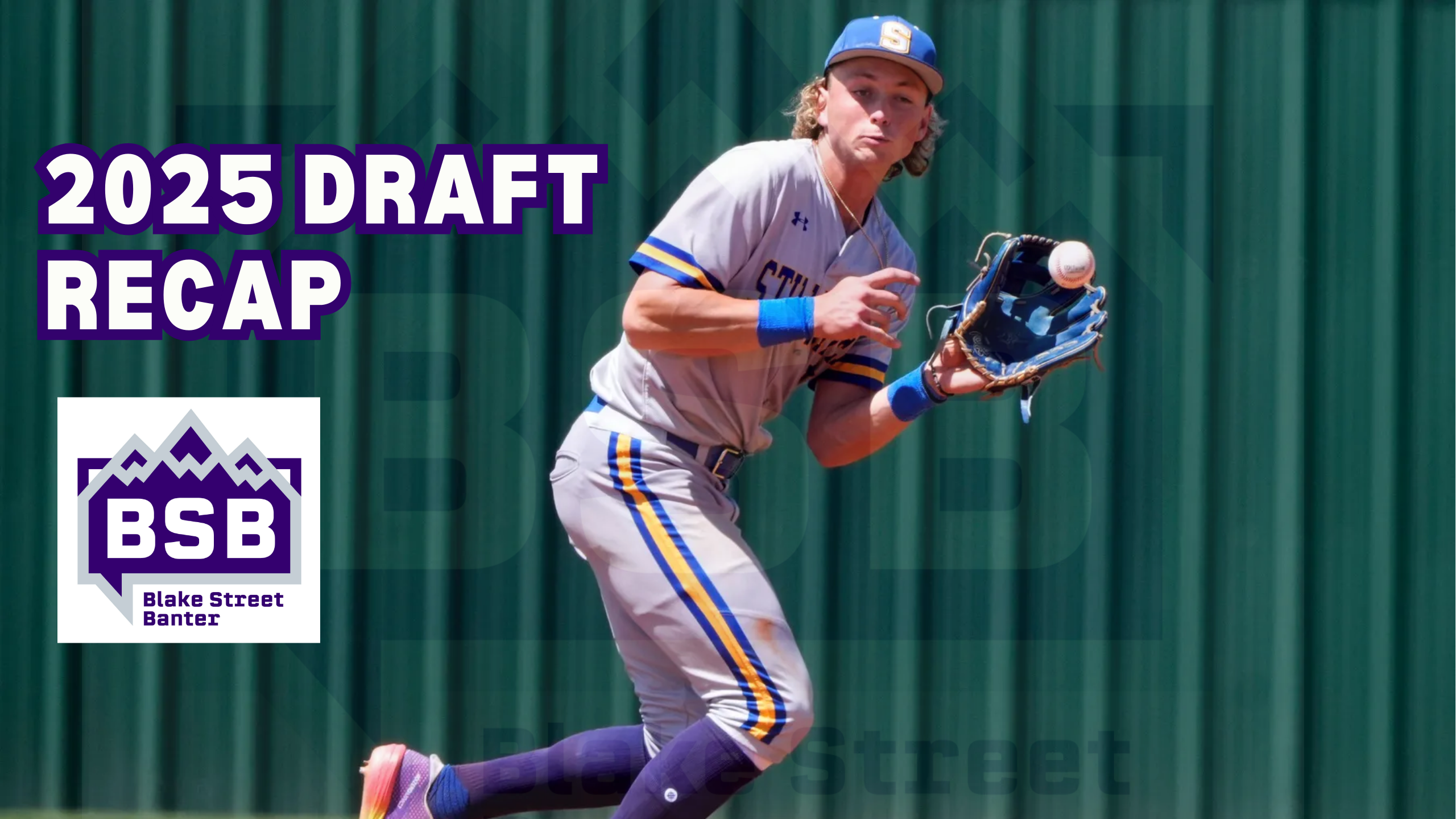
Another draft class is in the books and with that comes another draft recap and Ethan Holliday is officially in his Dad’s original organization.
Across all MLB organizations, there may not be a more thorough draft recap covering all 20 rounds. That’s to say, you’re in the right place to learn about all things related to the Rockies’ 2025 MLB Draft class.
If you find this recap to be fantastic, please consider donating a couple of bucks to help the operation of Blake Street Banter.

Day 1
Round 1 (#4 Overall) – Ethan Holliday, SS/3B, Stillwater HS (OK)
Bio
The son of Rockies legend Matt Holliday, Ethan joins the Rockies after claiming the Gatorade Oklahoma Player of the Year and asserting himself as arguably the best player in the 2025 draft.
Holliday smacked 16 home runs this season in 32 games, slashing .617/.737/1.309 (2.046 OPS). Comparatively, his brother Jackson hit 17 home runs in 40 games with a .685/.752/1.369 (2.121 OPS) in his senior season, placing the Holliday brothers on a similar trajectory entering the pros.
Player Summary
The 6-foot-4 youngest Holliday has long been known for his power. He’s a smooth swinging lefty infielder with easy power to all fields and impressive feel for the barrel to be able to lace line drives and fly balls around the ballpark. It’s his loose, fluid swing and 70-grade raw power that give rise to such a high-end prospect profile.
There are some hit tool concerns with Holliday, however. He has swung and missed a fair amount versus higher end national talent, creating some risk around his profile, though with such a smooth swing it’s fair to assume reps and some slight compaction or shortening of his swing will lead to more normal contact results.
Holliday can also be somewhat passive at the plate, though he’s usually more disciplined than passive. He should walk at an above average rate and work quality plate appearances consistently.
Defensively, Holliday is likely destined for the hot corner but his actions at shortstop are quality and he’s likely to remain an average defender there early in his pro career. The arm talent here is above average and Holliday is built for the left side of the infield in some capacity.
Holliday is not a great runner but typically picks up average run times, though he’s likely to tick down a notch as he physically matures. The physical projection remaining in Holliday’s frame provides further intrigue he can become a premier MLB slugger, capable of 30 or more home runs.
Round 2 (#45 Overall) – J.B. Middleton, RHP, Southern Mississippi
Bio
Southern Miss’s ace in 2025, the 6-foot Middleton is a twitchy and quick arm. He dealt a 2.31 ERA across 105.1 innings this year, striking out 122 while walking just 25.
Born and raised in Mississippi and ranked as the 18th best player in the state in 2022 before ascending with Southern Miss.
Player Summary
Middleton is electric on the hill while remaining in control of his stuff. The fastball sits 93-95, touching 97 coming from a three-quarters slot allowing it to play up in the zone without relying on spin. The heater limited hitters to a .662 OPS this year and picked up a solid 44.5 groundball percentage.
Middleton’s second pitch is a power slider that works like a cutter with hard cutting action up to 92. It’s a pitch that can saw off lefties and wipeout righties, working a .455 OPS on the season with a solid 41.1 whiff%.
Middleton’s changeup is only used about 10% of the time but can touch 89 with late run and some fade to make it a bat misser and a weak contact machine. The offspeed generated just a .215 OPS against it with a stellar 52.7 whiff%. This can be his most effective pitch but works best as a change of pace pitch to tunnel off his fastball.
Middleton has mixed in a more traditional cutter that can get into the mid-90s and adding a 4th shape to the arsenal could make the Mississippi product a legit #3 starter in a rotation and even higher in the Rockies crop.
Competitive Balance Round B (#74 Overall) – Max Belyeu, OF, Texas
Bio
Belyeu has been a 2-year starter in the corner outfield for Texas, logging 27 homers over the last couple seasons in just 91 games. Hailing from East Texas, Belyeu blew up at Texas and physically developed into an athletic specimen, capable of contributing in all aspects of the game.
Unfortunately, Belyeu missed most of the 2025 season with a thumb injury and could not build the type of momentum that might have vaulted him into the top 40 selections.
Player Summary
As mentioned, the tools are present here for Belyeu. His 90th percentile exit velocity stands at an impressive 106.7 mph which equates to at least 55 grade power and his max exit velocity was all the way at 112.6 mph. There’s big time power potential in Belyeu’s more compact swing.
As a hitter, Belyeu needs some polish with a zone contact rate of 83.5 which is a tick lower than average while his 28.9 chase rate is higher than average and will need to be honed in. Belyeu has struggled to produce against breaking balls but is one of the best fastball hitter’s with a 1.349 OPS against heat.
Belyeu can get by in center field defensively but may fit best in a corner long term where his plus arm can be an asset. This pick is very reminiscent of Jared Thomas who was Belyeu’s teammate for a couple of seasons at Texas. The raw ingredients are here for a quality 5-tool outfielder and if early results from Thomas are any indication, the Rockies could have a pair of UT outfielders on their big league roster.
Round 3 (#77 Overall) – Ethan Hedges, 3B, USC
Bio
A two-way guy at USC, Hedges logged 15 innings on the hill this year with a 2.40 ERA but his future lies at the hot corner. His 1.081 OPS this season stands out along with 14 homers and 44 walks to 50 strikeouts.
Player Summary
Hedges is hit over power with average contact (86.4% z-con) and chase (24.4%) rates that give him a shot to hit the ground running in the pros. The power is somewhat limited here (103.6 90th EV) but Hedges has proven he can get it in game thanks to a consistent line drive oriented swing.
Hedges has crushed fastballs to the tune of a 1.190 OPS against, showing their may be a trend in this draft of targeting fastball killers.
Defensively, Hedges is polished with quality footwork and actions and his arm (up to 96 on the hill) allows him to be an asset in the field.
If you can get an average hit tool to pair with quality defensive contributions, Hedges can become a low end regular or high end backup.
This pick likely comes in underslot to support a draft record bonus for fellow infielder Ethan Holliday.
Day 2
Round 4 (#107 Overall) – Riley Kelly, RHP, UC Irvine
Bio
Hailing from Orange County, Kelly stayed local and served as a cog in Irvine’s rotation this year with a 3.78 ERA in 66.2 innings. He struck out 70 and walked 32.
Player Summary
Kelly is known for his electric 3,000 rpm curveball that gets about 60 inches of drop from his higher arm slot. It sits 78-81 and is a true weapon and potential plus pitch. Kelly induced just a .420 OPS against his slider with a 35.6 whiff%.
Kelly’s fastball is a quality offering sitting 90-93, touching 96 with quality carry up in the zone and 6.75 feet of extension. It can be an above average offering in its higher velocity range. The fastball-curveball pairing for Kelly could make him a viable starting pitching prospect alone.
Kelly also mixes in a changeup that sits 82-85 with low spin and more subtle break to tunnel with his fastball. It’s a roughly average pitch but managed to miss bats at an elite 57.1% rate this year.
Kelly has the makeup of a backend starter but his curveball could become a weapon in a bullpen if that is his eventual home.
Round 5 (#138 Overall) – Cam Nelson, OF, Wake Forest
Bio
A Baltimore product, Nelson joins the Rockies after 2 seasons at Wake Forest where he was a part time player, logging just 77 games an 228 plate appearances. This season, Nelson logged an impressive .974 OPS in 91 plate appearances with a homer and 20 walks to just 13 strikeouts. Nelson also logged a few innings with Wake Forest last year and touched 95 mph.
Player Summary
Nelson will contribute to the Ethan Holliday overslot bonus efforts as a well underslot signing. His hit tool–though in an exceedingly small sample–hints at above average potential. A 86.8 zone contact rate and 9.7 chase rate are both above average with the chase rate actually elite. If such quality plate discipline holds, Nelson could be an asset at the plate.
Nelson isn’t a noodle bat but his 102.3 mph 90th EV hints at 30 grade pop and possibly even a grade lower. He’s going to rely on line drives to make his worth.
Nelson’s speed is easily above average and possibly plus with home-first run times as low as 4.05 from the left side. There is intriguing leadoff-centerfield upside with Nelson, though he’s a classic underslot pick to support the Ethan Holliday bonus.
Round 6 (#167 Overall) – Matt Klein, C, Louisville
Bio
Next in the long line of standout Louisville catchers, Klein follows Will Smith, Henry Davis, and Dalton Rushing as recent products. Klein posted a .939 OPS with 5 homers this year with 19 walks to 16 strikeouts, though his season was cut short after being hit by a pitch.
Player Summary
Klein is a hitter first and foremost. His 87.6 zone contact rate and 22.6 chase rate are both above average and gives him a chance to slot into the 2 hole in an MiLB lineup and set the table. He mashes fastballs and holds his own against breaking balls, though a .386 OPS versus offspeed pitches is an area for improvement. Additionally, Klein’s 52.4 groundball rate likely led to him sliding out of the first 5 rounds.
Klein’s meager power output isn’t exactly telling of the power upside in Klein’s game. The Louisville product landed a 114.5 max EV this season and had a 90th EV of 105.7 which is around average.
Behind the dish, Klein has some inconsistent framing numbers, getting below average results stealing strikes below the zone and his caught stealing rates have been low throughout his career but he’s an average blocker. Klein’s eventual home may be first base, though with the recent success of Hunter Goodman defensively, sticking at catcher is not out of the question.
Round 7 (#197 Overall) – Antoine Jean, LHP, Houston
Bio
Jean’s career is a rollercoaster. He turns 24 in a few weeks and finishes his 5th collegiate season, though Tommy John deprived him of a junior season in 2023 when he was draft eligible. Jean landed at Houston for a pair of seasons after and lit the Big 12 on fire this year with a 2.55 ERA and 110 strikeouts in just 67 innings, spending time as a closer and short-starter.
Player Summary
Jean likely would’ve landed in the top 100 selections if he was a year younger. His fastball has quality life up to 96 which led to a .475 OPS against and a 22.8 whiff%.
The bread and butter here is a pair of potentially plus breaking balls. Jean throws his slider a touch more, sitting 83-86 with depth and an upper 70s curveball that drops off the table. Combined, hitters recorded just a .357 OPS against them and whiffed on 48.5% of their swings.
Jean also has a changeup in the mid 80s relying on deception more than movement. It missed bats (50% rate) but hitters tagged it for a .992 OPS.
Jean has some durability concerns and his age indicates his upside might be capped but he’s one of the more effective lefties available on day 2 of the draft with the upside to crack a rotation, though he profiles best as a reliever long-term.
Round 8 (#227 Overall) – Tanner Thach, 1B, UNC Wilmington
Bio
A North Carolina native, Thach was an intriguing prep hitter in 2022 but lived out a decorated collegiate career instead at UNC Wilmington. He slugged 54 homers in 3 seasons, including 27 in 2024. His power took a step back in 2025 (12 homers) but he made big strides as a hitter.
Player Summary
Thach is a sturdily built 1B-only player with masher potential and surprisingly good feel for contact. His zone contact rate of 88.7 is above average, especially among players with some thump. A 90th EV of 105.9 evidences the above average power here that can play with frequency because of Thach’s quality feel for contact.
Thach is a bit of a free swinger (35.1 chase%) which has capped his production overall and places substantial risk on his profile as he enters the pros.
Thach’s swing is geared to elevate the baseball, giving him 25 homer upside in the pros with a chance to keep his strikeout rate in the low 20s. After building his resume as a premier collegiate power hitter, Thach will have some leverage with substantial NIL opportunities in the transfer portal so expect this to be a slot signing, potentially even a hair above slot.
Round 9 (#257 Overall) – Zach Rogacki, C, Binghamton University
Bio
Rogacki hails from the smaller America East Conference and Binghamton University where he was a solid 2 year player following a stint at Alvernia University. This season, Rogacki hit 8 homers and walked 28 times to just 22 strikeouts with a 1.037 OPS, splitting time behind the plate and in the outfield.
Player Summary
Rogacki is a pure contact hitter with sound swing decisions. His 91.6 zone contact rate and 17.5 chase rate are comfortably above average, though he’s a bit of a softer hitter with an average EV of 83.5 and 90th EV of 101.5. He won’t hit for much power in the pros but can be a reliable on-base threat with quality catcher defense.
His blocking and receiving grade out around average with a near 30 CS% recorded this year.
Rogacki is another heavy underslot selection but provides backup catcher upside.
Round 10 (#287 Overall) – Austin Newton, RHP, South Florida
Bio
Newton never got to showcase his ability consistently at South Florida, picking up 43 innings over the last 2 seasons, striking out 44 in that time. Standing 6-foot-5, Newton has upside with his limited experience.
Player Summary
Newton tops at 98 with his heater that gets down in the zone from a 6-foot-4 release height. The pitch has an average profile but being able to reach the upper 90s gives Newton upside. Without much experience or innings under his belt, Newton will be a moldable ball of clay for development.
Newton also has a slider and changeup in the mix. The slider can reach 88 with quality drop, giving it average potential.
Newton may be given a chance to start early in his career but is likely headed for the bullpen where he can develop more slowly.
Round 11 (#317 Overall) – Zach Harris, RHP, Georgia
Bio
Harris served in multiple roles for Georgia the last two seasons, logging over 65 innings across 31 appearances, 12 of which coming as a starter. This past season, he pitched to a 4.55 ERA, striking out 31 in 27.2 innings. The Georgia native stands 6-foot-1, just under 200 pounds.
Player Summary
Harris throws a mid-90s 2-seamer that can get up to 98. It gets plenty of sink and has above average run; it has the potential to be an above average fastball. Harris gets well into his legs and ends up throwing from a very low three-quarters slow with some deception.
Harris also throws a slurvy slider and changeup. The slider gets almost 50 inches of drop which is nearly 10 inches more than average for a slider. The pitch sits 81-85, giving it true slider velocity and the chance to be above average. Hitters managed just a .439 OPS against the pitch with a 40.5 whiff%.
Harris’s changeup was even more effective with a 61.9 whiff%, thanks to above average movement on both planes. The pitch blends with his fastball masterfully with similar shape but with roughly 15 mph of velocity separation. This velocity separation can be a bit extreme at times with hitters able to recognize the fastball more easily but the changeup itself is unhittable.
Harris has the ability to close games early in his pro career and may get molded to that closer role long-term.
Round 12 (#347 Overall) – Brady Parker, LHP, Houston-Victoria
Bio
An athletic left-hander, Parker hails from Victoria, Texas near Corpus Christi. He pitched three seasons for local University of Houston-Victoria, peaking in his final season, logging 111 strikeouts in 79.2 innings with a 3.84 ERA.
Player Summary
Parker is primarily a two pitch pitcher with a fastball and slider, though he’ll mix a changeup in under 10% of the time. He tops out at 95 and sits 90-93 from a lower slot. It garnered a 12 whiff% this year.
Parker’s slider sits 78-82 and missed bats on 27% of swings, serving as his primary out pitch, flashing great feel for the pitch.
With some projection remaining, the Rockies will hope Parker can add a tick on his fastball and hone in his fastball command to potentially become a viable left-handed reliever.
Round 13 (#377 Overall) – Izeah Muniz, RHP, Mt. San Antonio College (CA Junior College)
Bio
Muniz pitched at Cal State Fullerton in 2022 before moving to the JuCo ranks in an effort to develop and get his name on the map. This season, he logged a 1.92 ERA with 126 Ks in 108 innings.
Player Summary
Muniz averages 92 on his fastball, touching 94 with some carry. He also throws a slider in the upper-70s with huge drop that can miss bats (50 whiff%). Information and data is limited from the JuCo ranks but Muniz has a couple of pro ready pitches.
Round 14 (#407 Overall) – Luke Broderick, RHP, Nebraska
Bio
A recent transfer from Iowa Western CC, Broderick found his way at Nebraska this season pitching to a 3.25 ERA in 36 innings out the pen as the ‘Husker’s primary closer. Broderick struck out 43 while walking 22.
Player Summary
Broderick has a funky delivery that results in an overtop arm slot, creating a downhill attack angle. His fastball sits 91-94, topping at 96. Because of his arm slot, the pitch is difficult to read for hitters anywhere in the zone. The pitch also gets sneaky cut on it that can saw off lefties.
Broderick throws a slider as his primary pitch around 60% of the time that peaks at 87 with healthy drop. Its -9.04 VAA is extremely steep for a mid-80s breaking ball. The pitch was hit to a .600 OPS this year with a 35.3 whiff%.
Broderick will be a full-time reliever from the get-go and with his unique high arm slot and downhill arsenal, he’s got the stuff to rise through the minor leagues.
Round 15 (#437 Overall) – Dylan Crooks, RHP, Oklahoma
Bio
Oklahoma’s closer this season, Crooks made his 4th year of college count, logging 16 saves with a stellar 1.69 ERA.
Player Summary
Crooks sits 92-95 with his fastball, locating it well and getting underneath the baseball at times to rise the ball up in the zone. Crooks also has a long and deceptive take back that makes him a tough read, especially for right-handed hitters. This helped the heater limit hitters to a .621 OPS.
Crooks also throws a slider and changeup, the slider sitting 82-85 with incredible results because of how well Crooks hides the baseball. His slider generated a 45.9 whiff% and an unbelievable .267 OPS.
Crooks’s changeup is a bit more run of the mill with a pretty straight shape, though some subtle drop can make it an effective offering to lefties in tunnel with his fastball. The offspeed tops at 88.
Crooks has the pedigree to close games in the minors and between Crooks and Harris (Rd 11), the Rockies will have a battle on their hands for save opportunities.
Round 16 (#467 Overall) – Seth Clausen, RHP, Minnesota
Bio
A 4-year player at Minnesota, Clausen worked late innings for the Golden Gophers this year and amassed a ridiculous 46 strikeouts in 32.2 innings, though he did walk 27.
Player Summary
Clausen sits 92-95, topping out at 97 with average carry. It’s got enough power to keep hitters off his secondaires of which Clausen has three that comprise about 70% of his usage.
Clausen’s curveball is his most frequented pitch, sitting 81-83 with huge drop. Hitters managed just a .529 against the hammer curve, swinging and missing on 33.8% of swings. Clausen can also tilt a slider that can touch 89 with quality depth, though it was hit harder this year.
Clausen’s arsenal is rounded out by a sub-1,000 rpm changeup with above average late drop, making it an extremely tough read for hitters (.442 OPS/53.5 whiff%).
Clausen has intriguing relief stuff because of a trio of quality secondaries with the curveball and changeup at least average offerings.
Round 17 (#497 Overall) – Derrick Smith, RHP, NC State
Bio
Smith sparsely pitched this season amid injuries but was stellar in 2024, amassing 41 strikeouts to just 11 walks in 29.2 innings.
Player Summary
When healthy, Smith sits 92-95 on his heater, coming from a lower slot that allows the pitch to ride up on hitters. His slider can be a plus offering, sitting 79-82 with huge drop and premium bat missing results. In 2024, Smith’s slider generated a 57.4 whiff% and .356 OPS against it.
The Rockies will hope Smith regains that form, now healthy going into his first pro offseason.
Round 18 (#527 Overall) – Tyrelle Chadwick, RHP, Illinois State
Bio
A starter the last two seasons for Illinois State, Chadwick has not found a ton of success in college but managed a 4.31 ERA this season with 43 strikeouts and 25 walks in 77.1 innings. The 6-foot-4 Chadwick is a Canadian product having lived in Alberta and British Columbia.
Player Summary
Chadwick sits 91-94 with a standard fastball lacking any standout traits though he does get the pitch downhill, making it suitable for groundball inducement.
Chadwick also throws a slider and has dabbled with a curveball and changeup. The slider sits 82-85 with below average shape.
Chadwick has the experience as a starter not usually found this late in the draft but the Rockies will likely try and alter his arsenal to better fit in a bullpen.
Round 19 (#557 Overall) – Easton Marks, RHP, Florida International
Bio
Born and raised in Denver, Marks is a local product with three years of collegiate experience under his belt, including a 3.49 ERA campaign this year backed by 72 strikeouts to 35 walks.
Player Summary
Marks sits 91-93 with plus arm side run that makes the pitch a potentially average pro fastball. Hitters managed just a .758 OPS against it–a solid result for a fastball.
Marks spins a cutter, curveball, and changeup, with the cutter getting around 30% usage and the curveball around 25%. The cutter sits 85-87 with good depth for a cutter. It garnered a .670 OPS against it and 38 whiff%.
The curveball ran a .412 OPS against and 34.4 whiff% while the changeup sat at .837 OPS with a 38 whiff%.
Marks ultimately marks a sleeper pick with a solid 4-pitch arsenal and starting experience. If his 2025 performance holds, the Colorado kid should pick up some pro starts with a solid fallback plan into the bullpen.
Round 20 (#587 Overall) – Ethan Cole, LHP, Augustana University
Bio
Cole has a large 6-foot-2, 230 pound frame and delivered three quality seasons for Augustana. In 2025, he finished with a 3.68 ERA and 66 strikeouts in 63.2 innings.
Player Summary
Cole sits in the upper 80s with his fastball and throws a slider and changeup as well.
Cole figures to pick up swingman innings and fill gaps in the lower minors.
Draft Impressions
Ethan Holliday’s Bonus
As I’m writing this before round 11 kicks off, it seems clear Ethan Holliday is getting a massive bonus. The Rockies day round 3 and beyond picks largely align with cost saving maneuvers. Don’t get me wrong, the Rockies aren’t saving in a literal sense, they are cutting costs on picks to supplement a bonus well over $9M for Holliday (the Rockies bonus pool was slotted around $8.8M for the #4 overall pick, meaning they need to create the extra few hundred thousand by taking away from other picks).
If I had to guess, Holliday is just eclipsing the $9.25M draft record set by Charlie Condon and Chase Burns last season. I’ll project $9.3M; the league doesn’t inflate the draft pools every year for players to just accept last year’s money.
If that’s the case, Colorado will need to have created about $500K through round 10. Here’s how I imagine they did that:
- Ethan Hedges:
- The 77th pick was slotted for $1,060,300. I imagine Hedges goes about $200K below this (lines up with a bonus around the end of round 3).
- Cam Nelson:
- Nelson was not on MLB or Baseball America’s draft board but was selected with a pick holding a $529K bonus. He’s likely to sign for a couple hundred thousand below that mark, possibly as low as $150K which is the bonus for a day 3 pick.
- Zach Rogacki
- Coming from such a small school as a senior with minimal power, Rogacki may have been a UDFA target if not for appeal as a senior sign. He likely gets less than half of his $210K bonus slot.
Early Hitting
The Rockies cornered hitting early, obviously taking Ethan Holliday and then Max Belyeu, Ethan Hedges, Cam Nelson, Matt Klein, and Tanner Thach as notable offensive prospects before picking up Zach Rogacki as well, selecting just four pitchers through their first 11 selections.
The club didn’t load up on power bats and seemed to create a new target player model. All of their college selections have at least average hit projections and generally lack in the game power department, aside from Thach.
Loads of Relievers
As one would expect, the Rockies spent all of their last 10 picks on pitchers, prioritizing quantity over quality on the pitching front with all but maybe a pair of the arms profiling for the bullpen.
I would have liked to see the club uncover a hard thrower of some kind, instead settling for lots of arms in the low-mid-90s range with quality secondaries. Lots of steeper breaking balls selected like Kelly (R4), Newton (R10), Harris (R11), Broderick (R14), and Clausen (R16).
Between Harris, Broderick, Crooks, and Clausen, the Rockies assembled a fearsome foursome of proven college relief arms and all four have the type of stuff to excel in the lower minors and potentially become legitimate relief prospects.
Favorite Picks
- Ethan Holliday
- By default, I’ve gotta include Holliday here because it was a change of pace for the Rockies to go after a risky upside play, though a more calculated risk unlike their occasional all-in selections of Riley Pint and Benny Montgomery–prospects whose first trait was risk.
- Max Belyeu
- Belyeu was destined for the top 50 before injury interrupted his season with the Rockies securing good value in a high upside and well-rounded outfielder a half round later than he could have gone.
- Matt Klein
- Klein has great hitting characteristics and the ability to hit the ball hard. He gives me strong Aidan Longwell vibes (2023 17th rounder who just keeps hitting).
- Easton Marks
- I like the deeper arsenal Marks brings, he’s the lone round 11-20 pitcher that I have confidence in starting some games, giving him a higher floor as a pro.
Leave a Reply