
Eli Whitney | April 25, 2026
The night Mickey Moniak heard his name called first in the 2016 MLB draft, about 180 people packed into his aunt’s house in Encinitas, California – friends, family, teammates, neighbors spilling through every room. She had hosted the whole thing, his aunt, opening her home to the kind of crowd that may only assemble once in a lifetime. Moniak, 18 years old at the time and one of the most talked-about amateur baseball players in the country, says it remains one of the most special nights of his life.
What he couldn’t know then was how long and winding the road ahead would be.
Before the Road Got Long
The foundation for that night had been laid quietly. Going into his senior year at La Costa Canyon High School in Encinitas, Moniak already had a sense that the draft might come calling in the first round. Rather than letting that knowledge tighten him up, it seemed to loosen something. He played that final high school season the way he’d played as a kid – for the joy of it, with his friends, without the weight of the future pressing down on every at-bat.
“It kind of freed me up,” he says, “just to have fun playing with my friends one last time, and enjoying being a high school kid.”
He had a good year. Good enough to go number one overall to the Philadelphia Phillies, good enough to find himself in his aunt’s living room surrounded by 180 people who loved him, watching his name flash across the television screen. What came next was the part nobody can really prepare you for.
Professional baseball has a way of greeting young players with enthusiasm and then quietly and gradually showing them everything they don’t yet know. For Moniak, the first hints came at the end of his short debut season in the Gulf Coast League, when the Florida heat and the accumulated fatigue of a schedule longer than anything he’d experienced began to wear on him.
“You get to those last couple weeks of the season, and things are getting hot, you’re getting tired, you’ve never played this many games in a row,” he recalls. “That’s where reality sets in – oh, this is something you’ve got to prepare for, and it’s a full-time job.”
The Year It Got Hard
But the real education came the following year, his first full season, in Low-A ball with the Lakewood BlueClaws in New Jersey. Moniak came in with momentum, put together a solid first half, and then somewhere around midsummer, the calendar caught up with him. His friends from home were finishing up their freshman years of college and coming back to Encinitas for the summer – beach days, late nights, and the loose freedom of being an untethered teenage. Moniak was thousands of miles away, living out of a bus.
“You’re stuck in Lakewood, New Jersey, taking 10-hour bus rides and doing the grind of the minor leagues,” he says. “I had a little bit of homesickness going into the second half of the year, and struggled quite a bit.”
The numbers reflected it. And for a player carrying the expectations of a first-overall pick, a slump isn’t just a slump – it arrives with a particular kind of noise. But what’s striking, in retrospect, is what Moniak took from that difficult stretch rather than what it took from him.
“The year prior, I was hitting .290 and telling myself I had a bad year,” he says, chuckling at the memory. “That goes to show the type of failure I’d endured up until that point.”
The lesson he eventually landed on wasn’t mechanical or technical. It was about proportion – about the danger of treating a 140-game season as if every single game carries equal and infinite weight. He had been pressing, snowballing, letting one night infect the next. When the season ended, he sat with it, turned it over, and came back the following spring with something he hadn’t fully had before: perspective.
“That learning moment I had in Low-A in 2017 still carries true to this day,” he says.
The proof showed up almost immediately. He opened his first High-A season, hitting .200 through the first month or so. A younger, less self-aware version of Moniak might have panicked. Instead, he held his approach, trusted the process he’d built over that hard summer, and finished the year at .270. The turnaround wasn’t so much mechanical. It was mental.
A Front Row Education
If you ask Moniak what he’d tell his 18-year-old self – the kid in his aunt’s living room, fresh off being selected first overall – he doesn’t hesitate.
“It’s not that serious,” he says, and the phrase lands with more weight than it might seem. It isn’t defeatism or indifference. It’s the kind of hard-won clarity that only comes from having cared too much for too long and finally learning where to put things down.
“At the end of the day, it’s a game. There are more important things in life – God and family. I think at times I got caught up in baseball a little too much and put a little too much pressure on myself. And I still do it to this day. It’s just human nature.”
He pauses, then smiles. “But yeah – enjoy the ride. Looking back on my minor league times, my buddies and I joke about it. Some of the most fun times we’ve had in baseball. Just being in those small towns, eating at Waffle House at midnight after a game. Some of my fondest memories.”
Moniak spent seven years in the Phillies organization, from 18 to 24, witnessing the franchise transform from patient rebuilder to legitimate World Series contender. As he matured as a player, by the time he made his debut at 22, the roster around him included Kyle Schwarber, Bryce Harper, Rhys Hoskins, and J.T. Realmuto—a constellation of stars from whom a young outfielder could learn an enormous amount, provided he was paying attention. Moniak was paying attention.
But he was also honest with himself about the reality of his situation. Philadelphia was built to win now, spending heavily on established players, and the margin for developmental at-bats was thin. There wasn’t space for a young outfielder to go out and get 100 plate appearances and work through his struggles in real time.
“The most at-bats I got in a stretch was maybe 20,” he says. “And then that was it.”
He understood, even then, that it was good for his career—learning things in that environment you simply cannot learn anywhere else, absorbing the habits and standards of players operating at the highest level. At the same time, he knew that truly discovering who he was as a big leaguer would require a different kind of opportunity. When a trade to the Angels came, it marked a transition: more leash, more reps, more chances to figure things out on the fly.
The friendships from those Philadelphia years are permanent, and he glows talking about them. Several of those teammates stood in his wedding. Others were there watching. The old minor league cliche – “these are the guys who are going to be at your wedding” – turned out to be true.
“I look back on all that time, the friends that I made,” he says. “Guys that were in my wedding, guys that were at my wedding. You always used to hear it in the minor leagues, and it held true, man. It was awesome.”
Mile High, Finally Home
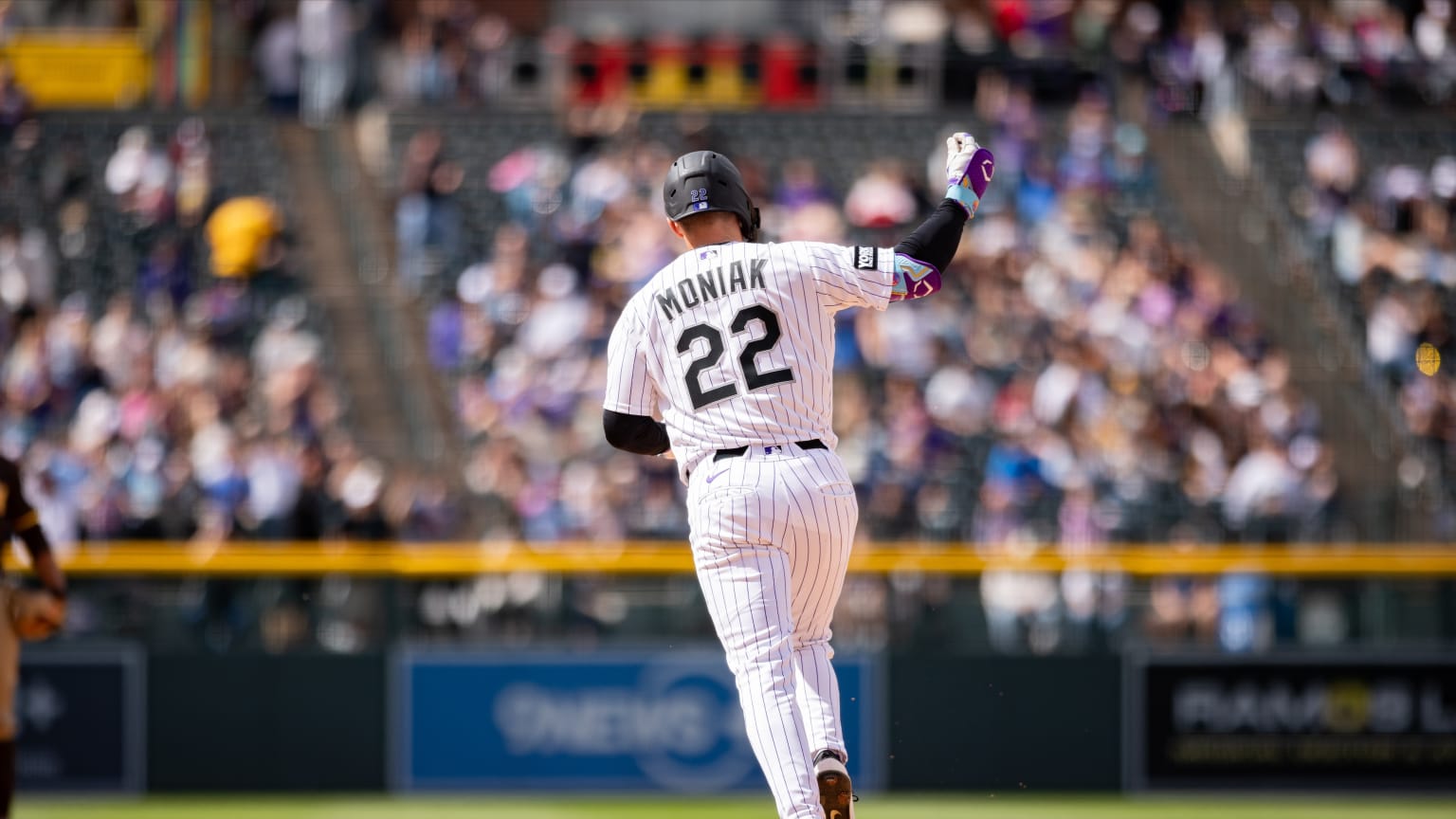
When the Rockies gave Moniak a chance following his release, what they got back was something the raw numbers from his career hadn’t fully advertised: a player who had done the interior work, who knew himself, who understood what it took to survive and contribute at the big-league level. The warm reception from Colorado’s fan base genuinely moved him.
“This organization believed in me,” he says. “These fans welcomed me with open arms last year and were unbelievable to my family and me. Anything I could do to give back to this organization – I want to be here for as long as I possibly can, hopefully the rest of my career.”
Within 13 months, Moniak has settled into a role that would have seemed improbable a few years ago: veteran presence in a young clubhouse, the guy the next generation looks to for cues. He spent years watching Schwarber, Harper, and Realmuto lead, quietly cataloguing what they did and how they did it. Now, still only 27, he finds himself on the other side of that equation.
“There’s always going to come a time in a career where you kind of transition from that young guy to the veteran presence,” he says. “Nobody tells you when it happens. It just kind of happens on its own.”
His approach is understated. He doesn’t try to install a new identity or manufacture authority. He leads by example, stays true to himself, and trusts that the players around him – many just arriving at the crossroads he crossed years ago – are watching. Because he was watching once, too.
“I just try to take things I learned from those guys and apply them here,” he says. “I definitely don’t try to change on a daily basis. I still try to stay true to myself.”
What is different now, beyond the role, is the rootedness. Moniak is married. He has a home in Colorado. The franchise that gave him a lifeline when he needed one has become something that he wants to be a part of for the long haul – not as a temporary stop, but as a destination.
“To be able to bring winning baseball back to Colorado would be one of the most special things I could do in my life,” he says. And listening to him say it, there’s nothing performative about it. He means it the way you mean something when you’ve thought about it a hundred times before anyone asked.
He acknowledges the Rockies are still working things out, but he sees the shifts happening – in the front office, in the clubhouse culture, in the mentality that manager Warren Schaeffer and the organization are bringing to the table – and he wants to be present for all of it.
The Distance Between Then and Now
Ask Moniak what emotion surfaces first when he steps back and takes stock of the whole journey – the crowded living room in Encinitas, the bus rides through New Jersey, the first big-league at-bat at 22, the years in Philadelphia watching greatness up close, the trade, the release, the second chance, the wedding, the new city, the new chapter – and the answer comes without any hesitation at all.
“Grateful,” he says. “Just to be able to play this game for as long as I have. You never know when that day is going to come when you’re done. I’m just trying to enjoy it while I can.”
He’s 27 years old. It’s been ten years since that night at his aunt’s house. He says, with the ease of someone who has not learned to take anything for granted and also not to sell himself short, that he hopes he’s got ten more.
Eighteen years old and first overall. Twenty-seven and finally home. The distance between those two things is the whole story.
Written by Eli Whitney


Leave a Reply