
Eli Whitney | July 20, 2026
The Rockies deadline sell-off has begun — and the first move is an unusual one.
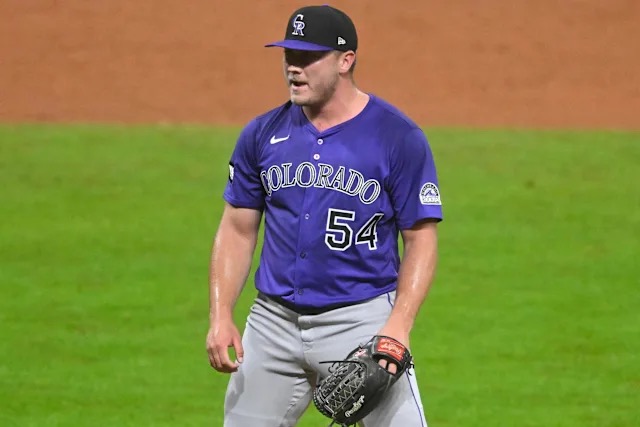
Colorado announced Monday that it had traded right-hander Seth Halvorsen to the Dodgers in exchange for Minor League right-hander Nick Frasso and Minor League outfielder Landyn Vidourek, a rare deal between two NL West rivals coming two weeks ahead of the trade deadline.
The returns follow a familiar deadline shape: one arm who could help soon, one position player who might matter later. Frasso will report to Triple-A Albuquerque and Vidourek to Low-A Fresno, while the Rockies remain at 40 on the 40-man roster — Frasso, who occupies a 40-man spot, slides directly into the space Halvorsen vacates.
The front office made it clear this wasn’t a move they went looking for.
“We’ve had a lot of interest in our young hard-throwing relievers, really going back to last winter,” president of baseball operations Paul DePodesta said Monday. “We’re not anxious to move any of those guys… it just had to make a lot of baseball sense for us. We had to be sort of compelled to do it.”
The compelling part, per DePodesta: “We were presented with an opportunity where we get a player that we think can actually fill a similar role to what we envisioned for Seth going forward, and also take a shot at a very high-upside third-round pick from a year ago.”
Halvorsen, 26, comes with more than five seasons of club control, meaning this is a long-term bet by Los Angeles on the arm, not a rental. And the arm is worth betting on.
Halvorsen’s fastball has touched triple digits since his debut, and his rise was fast — a seventh-round pick out of Tennessee in 2023, he reached Double-A by the end of his draft year and debuted in the majors in August 2024, posting a 1.46 ERA across 12 appearances. The results since have been rockier: a 4.99 ERA in 2025, then a 4.74 ERA with 15 walks against 17 strikeouts over 19 innings this season before he was placed on the 15-day injured list July 4 with right-shoulder inflammation. In 75 career appearances, all with Colorado, he went 3-4 with a 4.31 ERA. He made his first rehab appearance Sunday with Triple-A Albuquerque and is expected to remain in Triple-A as he begins his tenure with the Dodgers.
DePodesta didn’t downplay what’s leaving.
“I think Seth is going to be a really good major league reliever,” he said. “He’s already had some major league success. It’s obviously a huge fastball, and I think he’s got the right mentality to pitch late-game.”
Frasso is the near-term piece of the return, and in one sense the swap is symmetrical: both pitchers touched 100 mph in their respective outings the night before the deal.
“I don’t know how many trades there have been in baseball history where both guys threw 100 the day before,” DePodesta said.
The 27-year-old right-hander was ranked by MLB.com as the No. 80 overall prospect in baseball entering 2024, but his path since has been defined by injury.
“He got hurt and missed the entire 2024 season,” said general manager Josh Byrnes, who was with the Dodgers front office when Los Angeles acquired Frasso from Toronto in 2022. “Last year, didn’t quite return to form coming off the missed time and the surgeries, so they took him off the 40-man roster. This year, he kind of is back to what he was pre-injury.”
The numbers at Triple-A Oklahoma City this season back that up in ways the Rockies care about: 40 strikeouts in 24.2 innings, just two home runs allowed, against 17 walks — a 4.74 ERA that reads worse than the stuff underneath it.
Byrnes pointed to the delivery as much as the velocity: a 6-foot-5 frame, mid-to-upper 90s fastball, and an extreme release angle toward the third-base side that he called genuinely hard for hitters to pick up. One catch he acknowledged: Frasso is out of options at the end of the year, which made moving him “more palatable” to the Dodgers as they weighed their depth.
The Rockies see him as more than a one-inning arm. DePodesta cited Frasso’s starting background — he’s logged 51 starts among his 108 minor league appearances — and floated him as “a multi-inning reliever, even in leverage roles,” in the mold of how the club has deployed its other young arms. Asked whether a return to starting is on the table, DePodesta said the bullpen plan holds “for now,” and Byrnes added, “Never say never. I would probably say bullpen.”
He’ll report to Albuquerque — and he’s knocking on the door.
Vidourek is the longer-term swing, and neither executive dodged the .170 batting average at Low-A Ontario. Their answer, in short: the tools are why you make this bet anyway.
“Probably the most tooled, athletic player in the draft,” said Byrnes, who was also in the Dodgers’ front office when Los Angeles took Vidourek in the third round last year out of Cincinnati. “Top-of-the-scale exit velocity, top-of-the-scale speed, arm… Doesn’t chase and strikes out too much. So that was sort of the rub, and that’s continued this year.”
The profile is genuinely unusual: a .170/.332/.311 line propped up by a walk rate approaching 20 percent and a swing rate hovering around 40 percent.
DePodesta framed the discipline as the foundation rather than the flaw.
“He already has a very good strike zone discipline. He’s got big power. He is a good runner,” he said. “Now it just needs to be more balls in play when he decides to swing.”
Byrnes traced the passivity to Vidourek’s college role — “He was hitting leadoff in college. A lot of his strikeouts were called third strike. He was trying to table-set.” — and to a late start.
A former high school quarterback from Hamilton, Ohio, Vidourek is, in Byrnes’ words, “probably still in the learning phases of baseball development.”
There is also a Coors-specific angle to the fit. Vidourek is a center-field-caliber runner with a plus-plus arm that has already pushed him to right field at times, and DePodesta made the connection explicit.
“We like our corner outfielders here to be almost like center fielders who are playing in a corner.”
He’ll report to Low-A Fresno.
The intra-division element will draw attention, and Byrnes — whose Dodgers ties helped the deal come together — didn’t pretend otherwise.
“Anytime you make a trade, and you’re wrong, it hurts. If it’s in your division, it’s in your face a little bit more,” he said. “So, hopefully, we’re not wrong.”
He also noted the Dodgers’ recent track record of solving exactly the kind of arm they just acquired in Halvorsen — big velocity, unrefined command — which is either a reason for confidence in the process or the thing that makes this one sting later.
As for whether this opens the floodgates: “I don’t think this is like a true deadline trade,” Byrnes said. “This is more like a long-term baseball trade for both teams.”
With low payroll commitments beyond this season, he suggested the club’s real spending power could be deployed in the offseason — or the next 10 days.
More moves seem likely as the deadline approaches.
Leave a Reply