
Tyler Paddor | November 19, 2026
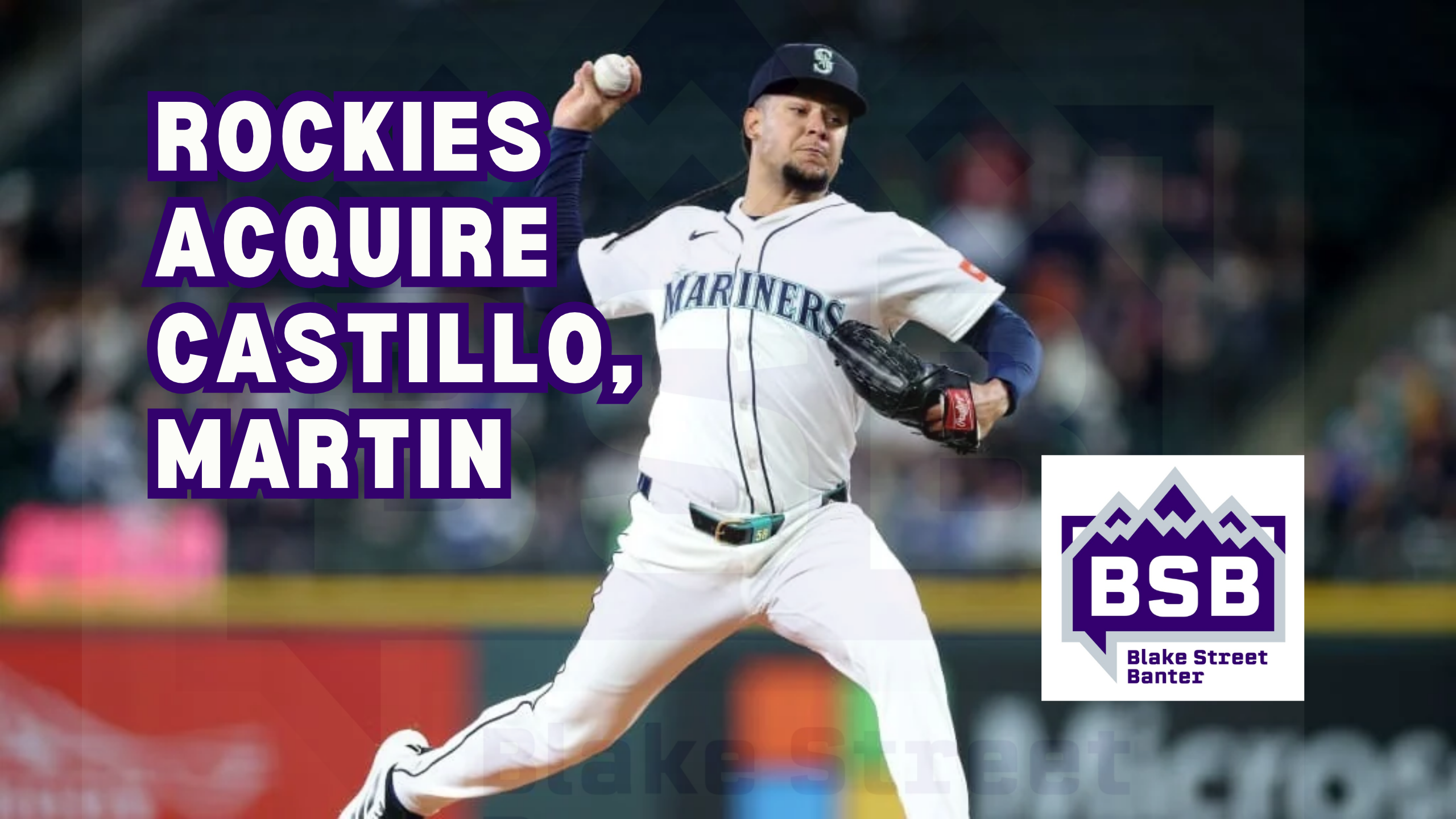
The Rockies came into the winter with a stated goal of rebuilding the starting rotation. They began that quest tonight by acquiring right-handed pitchers Davis Martin and Luis Castillo from the Chicago White Sox. Left-handed pitcher and former 2nd round pick Sean Sullivan and Venezuelan catching prospect Douglas Veliz will head to the White Sox.
Beyond planning to acquire starting pitching, the Rockies have also made clear they were looking to add salary. Their 2027 payroll was set to be some ~25M less than in 2026 before any acquisitions were made, the club received a multi-hundred million dollar investment from the Penner group midseason, and teams typically increase payroll year over year. That trio of factors guided the Rockies to make a decision like this trade, acquiring Martin (pre-arbitration; 4 years of team control) and Luis Castillo who is due $24.15M in 2027 before likely hitting free agency next season. Castillo has a $25M vesting option for 2028, though it will require him to reach 180 innings in 2027.
That 180 inning threshold is highly unlikely for Castillo, given the 2026 campaign he just wrapped up with Chicago. Castillo posted a career worst 5.85 ERA in 130.2 innings, including a bloated 8.42 ERA with Chicago over 31 innings. Chicago assumed Castillo’s big contract in an outside-the-box way to try and acquire starting pitching at the deadline, but following a nightmare stint with the club, they were desperate to get his $24M and change salary off the books by any means.
Those means included trading ascending starter Davis Martin, coming off a season in which he delivered 146 innings of 3.95 ERA ball. With Martin still under team control for four more seasons, the Rockies sending a lighter return of Sean Sullivan and Douglas Veliz is a testament to Castillo’s sunken-Titanic trade value.
Sullivan was primed for a 2027 bounceback after reaching the big leagues in 2026 amidst a bout with arm fatigue. Sullivan’s fastball was down several miles per hour from it’s usual — already slow — 90 mph and it resulted in an 8.87 ERA across 5 starts. The ultra deceptive lefty still holds plenty of promise but given his 40-man status and need for substantial growth, he was an asset the Rockies could part with.
Veliz is still 17, coming off an excellent pro debut down in the Dominican Republic. Veliz notably drew 26 walks to just 18 strikeouts and posted a .971 OPS as a catcher. While Veliz could certainly become a notable prospect, he’s a project and throw-in type of prospect for Chicago.
So just what are the Rockies getting in Martin? And is there a chance they can turn Castillo around somewhat?
Davis Martin
Martin is a well-rounded, though unflashy arm. He has a deep 6-pitch arsenal headed by a pair of low-90s fastballs, though his changeup also averages around 90 mph.
There is not a single above average offering in Martin’s bag but due to his solid command, all 6 pitches can play a part, though Martin’s cutter was hit to the tune of a .402 wOBA, almost 40 points higher than any of his other offerings. Both Martin’s slider and curveball pulled a whiff rate over 35.9% which is around average for MLB breaking balls.
The culmination was a hugely productive 2.6 fWAR season with the aforementioned 3.95 ERA and 122 strikeouts to 46 walks in 146 innings. Martin only allowed 14 home runs as well, though his 43.4 ground ball rate is just around the league average.
Under the hood, Martin’s 3.95 ERA may have been an overperformance with plenty of hard contact allowed, but the commitment to limiting walks and keeping hitters on their toes with a diverse arsenal should allow him to remain a serviceable MLB starter for years to come.
Martin overlapped with new Rockies pitching coach Ethan Katz in the early 2020s and Katz will be able to hit the ground running with Martin to gameplan for 2027 opponents.
Luis Castillo
Castillo had a fabled career starting from the moment he debuted with the Reds in 2017. From 2017-2025, Castillo ranked 10th in all of baseball in fWAR, 7th in strikeouts, and 6th in innings pitched. Through 2025, Castillo only posted an ERA above 3.98 one time, though the wheels came off this past season amid a spike in home runs allowed, likely due to an increase reliance on command due to slowly waning stuff.
Back in 2020 (beginning of Fangraphs’ Stuff+ measure), Castillo’s 110 Stuff+ was near the top of the league and remained between 103 and 108 for the next 4 seasons before trickling down to a slightly below average 98 in 2025 and a 96 this past season.
While Castillo’s stuff is diminished, his fastball velocity has held true, still sitting at 95.2 this past season, right around his average from the last pair of seasons.
Castillo’s calling card has always been a heavy running fastball that gets huge armside movement in the mid-90s. It was still mostly effective in 2026 with just a .245 average against it, although when it did get hit, it was hit hard.
Castillo’s slider notably dipped considerably this past season. Hitters missed on just 26.9% of their swings against it this past season versus steady upper 30 percent rates throughout most of his career. The slider was less sharp this year with more gloveside breaking sliders proving more effective and Castillo down multiple inches of overall movement this year from year’s past.
Trying to make the most of Castillo’s slider will be the key to getting any sort of production out of the 3-time All-Star, as it’s effectiveness makes or breaks whether hitters can hunt the fastball or not.
Castillo also throws a changeup he’s never quite been able to rediscover since 2021 when it was his most used pitch. It may be unrealistic to expect the changeup gets rediscovered, though the inconsistency of the offspeed pitch has been a direct tie to Castillo’s decline as relying primarily on a fastball combo (Castillo also throws a sinker) and slider can only be so effective in the rotation.
That brings us to the very real possibility that Castillo ends up a cog in the Rockies bullpen. The White Sox inevitably tried to get value out of Castillo in the bullpen, though he was clearly so out of sorts that the length of outing did not make a difference.
In any event, the Rockies made a key stride in adding innings to their big league staff. Martin should be a stable presence in the rotation and potentially the club’s #2 option, depending on their pursuit of other pitchers. Castillo comes with upside if he and Rockies brass can slow his decline and make necessary adjustments, but could be a key bullpen piece, in any event.
The Rockies still figure to add plenty more pitching to the MLB pitching staff this offseason, but in starting from the studs of a foundation, this is an essential building block of a trade towards stability in 2027. That is if we get baseball at all.
Leave a Reply