
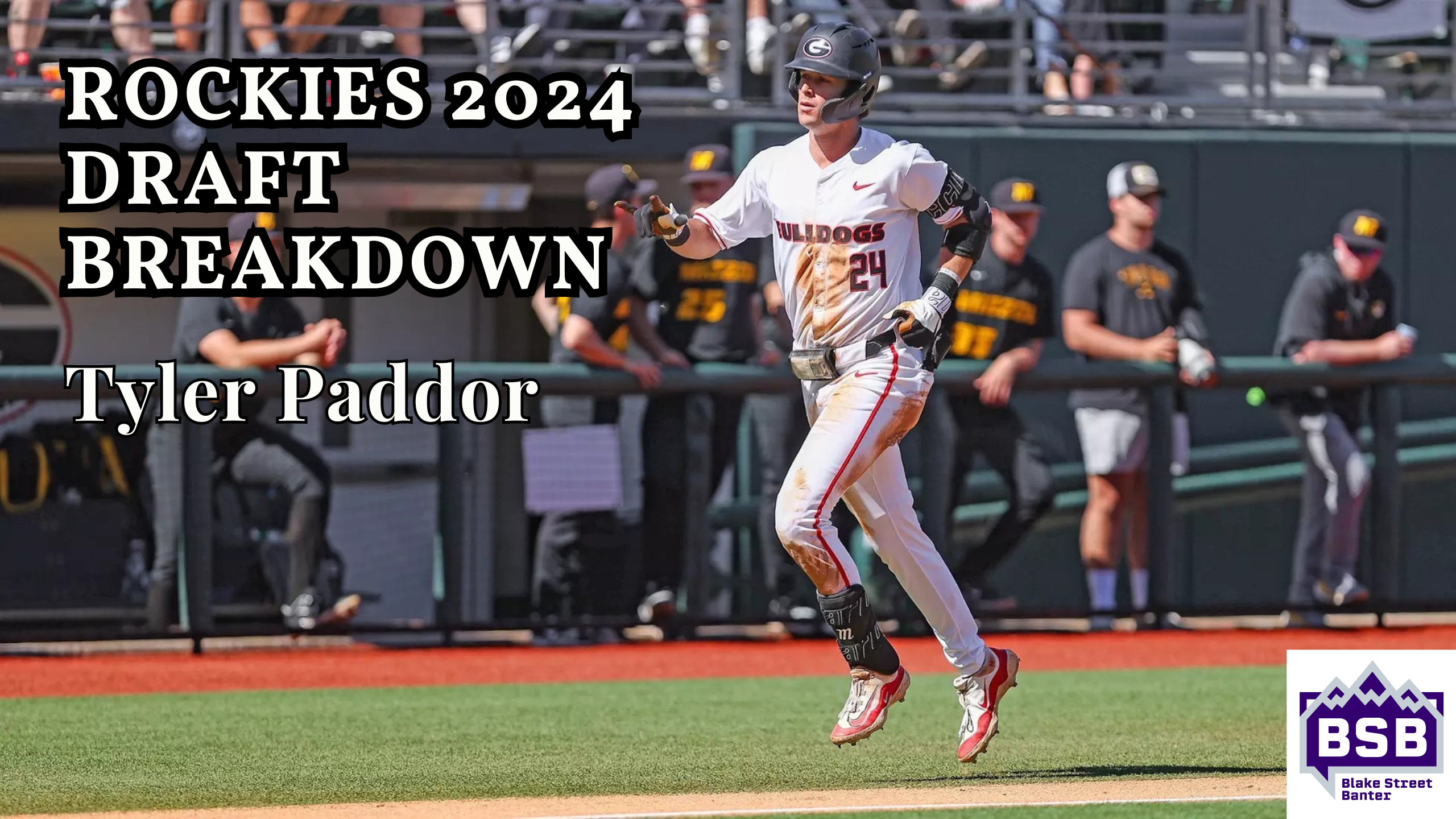
What a draft it was for Colorado. What seemed like an improbable start when Georgia superstar Charlie Condon became available to the Rockies at pick, became even more improbable when preseason top-10 pick Brody Brecht slipped all the way to pick 38. The Rockies capped day 1 with Texas outfielder Jared Thomas.
Below is a table of contents to help you more easily navigate to the player write-ups of most interest.
On day 2, the Rockies started by seeking even more offensive power, selecting a pair of 20 home run hitters, followed by a string of pitchers with limited upside, though some likely big league profiles.
Day 3 is always a rollercoaster but there are always legit names to circle. The Rockies checked many of the boxes you want from a draft class including another catcher, some left-handed pitching, a couple of power pitchers, middle infield depth, and more.
To follow is an extensive pick-by-pick breakdown of the Rockies class, comprising 21 players.
Day 1 (Rounds 1 & 2)
Round 1, Pick 3 – Charlie Condon, 3B/OF, Georgia
2024 Stats: 304 PA, .433/.556/1.009 (1.565 OPS), 37 HR, 57 BB/41 K
Again, the Condon pick was not projected by many mocks, though it had been speculated the Rockies would pay the 6-foot-6 slugger their full slot, if not more, to push Cincinnati off the pick (they selected RHP Chase Burns instead). The Rockies rushed their pick to the podium to take one of the most highly regarded prospects in the organization’s history.
The report on Condon is no secret. It’s legit double-plus (70 grade) power as evidenced by his 90th percentile exit velocity of 111.8 mph. Few players in the Trackman era have recorded such a mark and quite literally zero others have posted such a mark with the subsequent stats Condon posted.
The versatile Condon ran a stellar zone-contact rate of 89%. For reference, the D1 average was 84.4% and that includes plenty of players with a shred of the power that Condon boasts. Further, Condon’s chase rate of 22.5% was a solid mark, a tick better than the D1 average of 23%.
No collegiate player in the Trackman era has recorded the exit velocities Condon has with his zone-contact rate and chase rate in combination. It’s a complete offensive package we haven’t seen since the likes of Kris Bryant–a legendary college baseball player with a fabled early MLB career.
Condon also carries one of the most important traits in today’s game–he can elevate the baseball with ease. The preferred walk-on had a ground ball rate of just 31.9%, barrelling the ball with frequency and in the air. While hitting the ball hard is great, it’s the ability to put it in the air that gives rise to a potential all-world slugger.
In terms of his approach, Condon is on the more aggressive side–which makes sense for a player with his power and ability to make contact. He could use to refine his zone awareness some, but getting plenty of swings off is exactly how he projects to be a 35-40 home run hitter.
Most impressively, Condon crushed every single pitch type this year.
| Pitch Type | OPS |
| Fastball | 1.590 |
| Slider | 1.663 |
| Curveball | 1.541 |
| Offspeed (CH + SPL) | 1.223 |
Condon pulled off a wicked 1.796 OPS against pitches 94 mph and above (1.833 against 96+), showing he can handle the heat. Condon also features impressive plate coverage and can handle just about any pitch location, though he’s a prodigious hitter of elevated pitches while just great against the lower third of the zone.
In terms of his defensive home, Condon was announced as an outfielder, though it’s known he’s experienced at third base as well. If the Rockies want him in the big leagues faster, the outfield will be an easier position for Condon to master, though sustaining some positional versatility never hurt.
Condon doesn’t project to be a special defender but he played very well this season between 3B, LF, CF, RF, and some 1B. He’s got an easy above average arm and solid footwork and overall athleticism for a player of his size.
Condon has largely been timed in the 4.4-4.45 range up the line which equates to below average (40 grade) speed, though he’s certainly capable of getting up to solid top speeds.
The cherry on top here is that Condon truly didn’t find his niche with baseball until his second year at Georgia in 2023. Condon was not recruited heavily by D1 programs and was without notable options. He lacked some of the confidence that comes with being an acclaimed high school player, confidence that finally arrived after making use of Georgia’s facilities and adding strength while also polishing his skills.
Condon has always pursued baseball, but the astronomical levels of development since stepping foot at Georgia suggest he may be an extremely coachable, adaptable, and hardworking specimen. There’s potential to be one of MLB’s premier power hitters. Watch out MLB.
CB-A, Pick 38: Brody Brecht, RHP, Iowa
2024 Stats: 78.1 IP, 3.33 ERA, 1.21 WHIP, 49 BB/128 K
The Rockies got arguably the most explosive pitcher in the entire draft in Brecht. The Iowa product was viewed as a top of the first round type of prospect coming into the year, though command issues persisted and allowed the flamethrower to slide to pick 38.
Brecht’s calling card is an upper-90s fastball that has touched 104 in the past, though more usually sits 96-98, occasionally touching 100. It’s a steeper fastball that generates a lot of groundball contact because Brecht pitches from a high arm slot, thus launching the ball more downwards. Brecht may be the first pitcher the organization has had to combine such groundball inducing qualities with elite velocity.
Otherwise, his fastball is metrically around average. It gets below average movement on both planes and Brecht averages just 5.6 ft of extension to home plate (6 ft is average). The velocity will carry this pitch into being easily plus (60-grade) and the unusual angle to home plate makes it potentially double-plus (70-grade).
On the season, hitters managed a .686 OPS against Brecht’s fastball while he picked up a 25.4% whiff rate, both of which are easily above average.
Brecht’s second pitch is a premium upper-80s slider. It averages 87 and can get up around 92. The pitch features excellent depth (drop) which at high velocity, makes it nearly unhittable. Brecht’s slider garnered a 56.7% whiff rate and hitters scraped together a meager .464 OPS against it. It’s one of the steeper sliders you’ll find which helps Brecht accumulate tons of weak ground ball contact.
Finally, Brecht throws a split-changeup around 10% of the time–though the Rockies will certainly be looking to continue developing this pitch. Brecht kills spin on it–an ideal trait to help it get more knuckling move and rely less on spin which is less effective at altitude–and throws it with extreme deception.
The pitch’s movement is around average but when it’s consistently thrown 89-92 mph, it can be a wrecker of an offering. Hitters posted a .527 OPS against it and missed on 43.3% of their swings. It’s comfortably an above average pitch with a chance to develop into a special third offering.
Control and command are certainly red flags in the profile here and the only reason Brecht was able to get this far–though no matter how you slice it, this was a bargain for Colorado. Brecht walked 14.2% of hitters he faced, a somewhat higher than average mark, though certainly nothing gravely concerning.
Prior to this season, Brecht was a promising player on the Hawkeyes football team, recording 9 receptions as a freshman before stepping away to focus on baseball. We see time and time again that once players remove one athletic commitment from their plate, they begin to excel at their sole focus–just look to Paul Skenes in his first year as a pitcher only.
While many fans were clamoring for Chase Burns, Brecht brings rivaling stuff though without the same amount of control. With more focus on baseball and professional pitching development, Brecht’s ceiling is truly limitless and he carries ace potential, though comes with serious reliever risk.
Round 2, Pick 42: Jared Thomas, OF/1B, Texas
2024 Stats: 291 PA, .349/.435/.635 (1.069 OPS), 16 HR, 18 SB, 31 BB/60 K
Thomas wasn’t at the top of everyone’s mind when the Rockies announced pick 42, though some draft analysts are high enough on the Texas utility man to suggest this was not an unexpected pick.
The 6-foot-2, 190 pound sophomore carries unusual upside for a college player. First off, like Condon, his experience is limited with just two years of collegiate action. Secondly, his frame is still slight and suggests he might be able to tap into another level of strength and power. That alone warrants extra patience with the pick.
Still, there’s plenty to like with Thomas aside from the untapped ability. Thomas has a beautiful swing from the left side that has generated consistent hard fly ball contact. His ground ball rate of 32.5% is well above average and shows a legitimate strength in his game.
While Thomas doesn’t currently have above average raw power to match his lofty swing, his 105.1 90th percentile exit velocity is still around average and the projection remaining in his frame instills hope he might see a tick up to above average or possibly even plus power production based on the ability to lift the baseball.
Because of the legit ability to elevate and some quality bat control, Thomas has left the yard to all parts of the ballpark. Thomas has loose wrists that allow him to get all types of swings off and spray the baseball around; perhaps his most valuable skill as a hitter.
Thomas posted an 85.8% zone contact rate this year which is right around average. On the other hand, his chase rate of 28% is a shade higher than average and shows there is a bit of aggression to Thomas’s approach, though not close to problematic levels.
Thomas has some issues covering the outer half of the plate and doesn’t quite get A-swings off on pitches low and in, but neither weak spot is exactly a hole. Thomas absolutely mashes pitches up in the zone and has extremely quick hands to contact almost everything on the inner half. Against higher end velocity (94+), Thomas had an OPS of 1.120, showing he’s not vulnerable to pro level velocity.
Thomas has to further prove himself against more vertical breaking balls, as he had just a .630 OPS against pitches tagged as curveballs, though his 1.330 OPS against sliders shows it’s not an issue of picking up spin but rather getting on plane with steeper pitches.
Thomas spread his time mostly between centerfield and first base this year. As a runner, Thomas gets up the line between 4.2-4.3 typically, meaning he’s more in line with average speed but there’s certainly a good athlete here with smooth strides and he’s been dynamic in his base stealing attempts.
As a result, Thomas is a quality outfielder. He could likely handle center field early in his career but will most likely pick up time in an outfield corner where his solid average arm will play. Considering the positionality of later picks in this draft, it’s fair to assume Thomas won’t be a regular first baseman, though the Rockies may look to keep him sharp there.
Thomas provides intriguing upside with more power to be unlocked, consistently good contact quality, promising bat to ball skills, and versatility on the defensive side. Thomas won’t immediately slot in as a top prospect in the organization but there’s reminiscence of the Cole Carrigg pick here with a chance to immediately hit the ground running.
Day 2 (Rounds 3-10)
Round 3, Pick 77: Cole Messina, C, South Carolina
2024 Stats: 286 PA, .326/.465/.701 (1.166 OPS), 21 HR, 8 SB, 50 BB/67 K
The Rockies kicked day 2 of with some thump. Messina just looks like a classic power hitter from the 90s and 2000s. The slugging backstop offers immense power. His 108.2 mph 90th exit velocity is well above average and lends itself to legitimate plus (60-grade) power. That’s the calling card here.
Otherwise as a hitter, Messina–like Condon and Thomas–elevates the baseball. In fact, Messina’s groundball rate of 28.9% is one of the lower marks you will see at any high level of baseball. Messina has an unusual setup with his bat head draped behind his back around his lower back before kickstarting his powerful swing. The pre-pitch movement helps him initiate a bat path that gets under the baseball quite a bit.
Messina isn’t a precise hitter, though his zone contact rate of 83.8% is still around average and somewhat impressive given the power. Messina has a solid approach and ran a 22.3% chase rate this year, a smidge lower than average. He works counts effectively and is a mature hitter at the plate.
Messina has a history of hitting all types of pitches, though changeups and picking up offspeed offerings versus a pitcher’s fastball will be a key area for improvement. Messina can be beat up and away, otherwise his swing gets the job done.
Messina’s speed is as you’d assume for a strong, power-oriented catcher. He’s likely to stay a 30-grade runner, though he did steal 16 bags across the last two seasons.
The former Gamecock is going to get all the opportunity to stick behind the plate defensively. He’s got a sterling reputation as a teammate and leader, and has some workable tools as a catcher. Messina has solid hands and does a quality job framing pitches. As a blocker, Messina has flashed great fundamentals but can get a little too reliant on his glove when he gets crossed up. Messina’s arm is roughly average and he isn’t an enforcer of baserunners but there’s plenty to work with.
It’s unlikely there’s a high-end defensive profile here but Messina will handle pitchers well in the pros and do more than enough otherwise to provide some value. The real sticking point here is Messina’s huge power; he could potentially be a 25-30 home run type of bat, uncommon for a catcher.
Round 4, Pick 106: Blake Wright, 3B/2B, Clemson
2024 Stats: 285 PA, .340/.383/.652 (1.035 OPS), 22 HR, 16 BB/36 K
A somewhat surprising pick, Wright is a senior-sign that figures to save the Rockies money to fit the high-profiles of Condon or Brecht and/or accommodate a day 3 overslot into the bonus pool. However, Wright is a great player in his own right (no pun intended).
Clemson’s primary third-baseman was the heart and soul of the Tigers’ offense this year with an intriguing blend of power and contact ability. Wright’s 105.2 mph 90th percentile exit velocity supports at least average power, especially in combination with his stellar 32.3% ground ball rate (noticing a trend yet?).
Wright makes a ton of contact and has quick and precise hands to spread the ball all over the field. His 89.6% zone contact rate is well above average and he’ll be a tough hitter to put away. Wright is a pretty aggressive hitter, running a 28.7% chase rate and consistently looking to spoil 2-strike pitches instead of taking them to get in a more favorable count.
Wright has been solid against secondaries his entire career and worked a .943 OPS against all secondaries this year. He’s vulnerable to pitches up and away and his power mostly comes against pitches belt high or over the heart of the plate.
Defensively, Wright could be an above average third baseman, though the Rockies will certainly look to enrich his versatility by maintaining his aptitude at second base. The arm is average as third basemen go, which further supports a fit at the less arm-driven second base. Wright is a legit average runner and solid athlete.
The Rockies got a very high floor player in Wright with functional power and good feel for contact. As alluded to above, the Rockies very clearly targeted hitters that can elevate the baseball in this year’s draft as they attempt to correct the organizational imbalance of groundball prone hitters.
Round 5, Pick 139: Lebarron Johnson Jr., RHP, Texas
2024 Stats: 72.1 IP, 5.60 ERA, 1.70 WHIP, 44 BB/84 K
Most did not expect Round 5 to be where the Rockies took their second pitcher of the draft. Fortunately, they found quality stuff in Johnson–another senior sign that saves money for a purpose to be determined when players sign–and a starter’s pedigree.
In 2023, Johnson was dominant, posting a 2.91 ERA primarily as a starter but the stars didn’t line up for him to have his draft demands met. A step back in results in 2024 makes Johnson a legitimate discount signing but one that brings power and upside.
Johnson revs his fastball up to 98 and typically sits 93-96 from a higher release point to help steepen the pitch and generate more ground ball contact. The pitch got hit hard this year to the tune of a 1.055 OPS and the Rockies will need to optimize the offering.
To back the heater up, Johnson throws an easily above average slider that can touch 90 mph, sitting 85-88. Its break is more subtle and vertically-oriented, allowing it to play off the fastball. Johnson’s slider had just a .596 OPS against it with a 39.9% whiff rate, showing it can really perform at an above average level.
Johnson has mixed in a low-spin changeup that sits 86-89 and the kind of minimal action the tunnel well with his fastball. Small sample results were very favorable with a .357 OPS against the offspeed pitch and a 30.4% whiff rate.
Johnson’s strike-throwing comes and goes–though he was more consistent in 2023–and he’ll need to remain sharp to stay a starter in the pros, but this kind of power doesn’t grow on trees and Johnson will have a chance to work his way to MLB as a starter.
Round 6, Pick 168: Konner Eaton, LHP, George Mason
2024 Stats: 62.0 IP, 5.66 ERA, 1.58 WHIP, 34 BB/82 K
The Rockies continued a run on starting pitching, snagging Eaton from mid-major George Mason. Finding left-handed pitchers with legit pro stuff is a lot easier said than done and that’s exactly what Eaton provides.
He starts hitters off with a low-90s fastball, sitting 91-94, capable of touching 96. It comes from a 3/4 slot with good extension, allowing it to play up a tick from it’s measured velocity. A .907 OPS against the heater isn’t great, but there are traits to work with.
Eaton also throws a slider and changeup. His slider is easily above average, sitting 82-85 with massive depth for a slider. Hitters managed just a .656 OPS against it and missed on 34.4% of swings. There’s upside with the pitch but it will play in the pros right away.
Eaton’s changeup has potential as a mid-80s offering with good fade. A .550 OPS and 34.6% whiff rate suggest it’s an above average pitch.
Eaton has nibbled around the zone a bit too much and has walked his share of batters, but there’s above average stuff for a southpaw and he’ll get a long look as a starter.
Round 7, Pick 198: Fidel Ulloa, RHP, LSU
2024 Stats: 23.1 IP, 4.63 ERA, 1.32 WHIP, 11 BB/26 K
A full-time reliever in his one year at LSU, Ulloa got some of the team’s late-inning looks and was a solid piece of an SEC powerhouse bullpen. Fast forward a few months and Ulloa looked elite in the MLB Draft League, delivering 15 shutout innings in 3 starts, striking out 19 and walking 3.
On the surface, this looks like a reliever all the way but Ulloa’s dominance as a starter in a formidable league suggests the Rockies may extend his look out of the rotation.
At LSU, Ulloa mixed a fastball and slider together. The Draft League saw Ulloa unveil a sparingly used changeup and varying slider shapes, one resembling more of a cutter while the other was a more traditional two-plane slider. How exactly Ulloa will mix pitches in the pros is to be determined.
Based in certainties, Ulloa’s fastball is legit. It averages right around 94 and can touch 97 with some carry to play up in the zone and above average extension. Ulloa’s slider was excellent at LSU, limited hitters to a .479 OPS while missing bats (40% whiff rate).
This pitch pairing gives Ulloa a nice floor as a pro reliever but it will be the refinement of other pitch types that open the door to a starting gig.
Round 8, Pick 228: Luke Jewett, RHP, UCLA
2024 Stats: 82.2 IP, 4.35 ERA, 1.46 WHIP, 34 BB/72 K
Jewett jumped into a big role as UCLA’s Friday starter this year and did not disappoint, executing a 5-pitch mix well. There’s two distinct fastballs here (4S and 2S), a slider, curveball, and changeup. None of which are particularly special but all of which are usable.
Jewett sits 91-93 most nights but has grabbed 95 on occasion. Jewett’s curveball is his best overall pitch, featuring heavy drop in the upper-70s and allowing just a .636 OPS against it this year.
The changeup has flashed as an average or better pitch with low-spin in the mid-80s with good drop and subtle fade to play off Jewett’s fastballs. Jewett’s slider shows some promise with good depth and bat missing potential, but it was his hardest hit pitch this year.
This certainly isn’t a power arm but Jewett commands his arsenal fairly well and can give different looks to all hitters, making him a prototypical low-end starting pitching prospect.
Round 9, Pick 258: Tommy Hopfe, 1B/OF, Fresno State
2024 Stats: 288 PA, .360/.451/.547 (.998 OPS), 7 HR, 5 SB, 21 BB/38 K
A two-way player at Fresno State, Hopfe’s future is as a hitter with promising power (106.3 90th percentile EV) and elite bat to ball skills from both sides of the plate, evidenced by an overall 94.2% zone contact rate. Hopfe could use a touch more polish on his approach, but power and contact are king.
From both sides, Hopfe will contact practically everything in zone, though he’s particularly aggressive from the right-side waving at far more pitches. Unlike the rest of the class, Hopfe’s swing is oriented towards line drives and will result in more ground balls as we saw a 48.1% GB rate this year.
As a runner, Hopfe has legit average or better speed. He can get his 6-foot-1 frame up the line around 4.3 from the right side and 4.2 from the left. The athleticism suggests Hopfe will profile well in a corner outfield spot, though the majority of his defensive experience is at first base. Hopfe touched 94 on the mound this year and it would be wise to put that arm to good use in an outfield corner.
There’s much intrigue here as a contact-oriented switch-hitter with some raw power from both sides, especially as a solid athlete with a good arm. Keep an eye on Hopfe to post low strikeout rates in the pros and hopefully plenty of hits to match.
Round 10, Pick 288: Fisher Jameson, RHP, Florida
2024 Stats: 67.2 IP, 3.99 ERA, 1.15 WHIP, 18 BB/79 K
The Rockies closed day 2 with an SEC arm from the Florida pitching factory. Jameson is the opposite of the prototypical Gators’ pitcher. Instead of blazing stuff, Jameson has an aptitude for pitching and great command of his arsenal.
Jameson throws two different fastballs, a less effective 4-seamer and a quality 2-seamer that sits 92-94 and has reached 97. The 2-seamer has some sneaky late run and has been difficult for hitters to barrel with a decent .849 OPS against it.
Jameson’s slider offers real promise. It’s a heavy dropping slider with more of a curveball shape, though it sits 82-84, touching 87. Hitters have not figured the pitch out, producing just a .467 OPS against it and a 46.1% whiff rate.
With great command of two pitches, look for Jameson to get late inning looks in the pros.
Day 3 (Rounds 11-20)
Round 11, Pick 318: Alan Espinal, C, Vanderbilt
2024 Stats: 252 PA, .289/.398/.545 (.943 OPS), 13 HR, 33 BB/79 K
Espinal has power. He’s got a plus 90th percentile EV of 108.8 and it resulted in great production for a catcher. The hit tool is lackluster (somewhere between a 30 and 40 grade) as Espinal swings and misses a lot and chases quite a bit too.
There’s 109 collegiate starts of experience behind the dish and Espinal has an above average arm, so the Rockies are buying power and arm strength here and will look to polish the other defensive skills.
Round 12, Pick 348: Everett Catlett, LHP, Georgetown
2024 Stats: 77.2 IP, 3.36 ERA, 1.33 WHIP, 35 BB/84 K
Standing 6-foot-7, Catlett has one of the bigger left-handed frames you’ll see in pro baseball. He uses that frame to aid in his deceptive operation on the mound.
Catlett’s fastball sits 90-93 but has touched 96 and it seems reasonable to expect that Catlett still has room to grow, especially with just 106.2 innings under his belt at the collegiate level. Catlett backs it up with a wicked slider that hitter’s stumbled into a .355 OPS against.
Between the slider and Catlett’s power changeup, there’s a pair of intriguing secondaries here and, if another tick of velocity can come, Catlett could emerge as a legit prospect.
Round 13, Pick 378: Justin Loer, LHP, LSU
2024 Stats: 24.1 IP, 5.92 ERA, 1.64 WHIP, 12 BB/30 K
Loer is another deceptive lefty. He brings bat missing stuff (35.3 whiff% overall) and two viable secondaries in his slider and changeup.
Loer’s slider can touch 85 and got hitters to swing and miss 43.4% of the time, though the .943 OPS against suggests he’ll need to locate the breaker better. His changeup boasts stellar marks (.347 OPS against; 51.6 whiff%) and should aid his rise through the pros.
Loer’s fastball sits 89-91 and will top out at 93, but extension and deception allow the pitch to play up closer to average. This will be an interesting developmental relief prospect.
Round 14, Pick 408: Sam Gerth, RHP, Navarro College (TX Junior College)
2024 Stats: 55.2 IP, 6.47 ERA, 1.72 WHIP, 42 BB/68 K
Gerth is just a year removed from HS and was up and down at Navarro College, though he proved himself a pro arm with a fastball up to 95 and a slider that decimated hitters this year.
With a 6-foot-3 frame and some room to grow both physically and as a pitcher, this is a high-upside dart throw.
Round 15, Pick 438: Luke Thelen, RHP, Western Michigan
2024 Stats: 43.1 IP, 3.53 ERA, 1.38 WHIP, 23 BB/58 K
Thelen brings big time power on the mound having touched 99 this year with a fastball that sits 93-95 and misses bats (29.4 whiff%) because of good arm-side run. It also held hitters to just a .677 OPS.
Thelen backs it up with an above average slider, an upper-70s offering with big time drop. The 41 whiff% and .656 OPS against suggest it was extremely effective. There’s a budding changeup with big arm-side run, but it’s seen limited usage.
Thelen took massive strides this year as a pitcher and strike-thrower. If he remains in control of his arsenal, there’s big league bullpen upside.
Round 16, Pick 468: Kevin Fitzer, 1B/OF, Cal State Northridge
2024 Stats: 209 PA, .321/.429/.631 (1.060 OPS), 11 HR, 11 SB, 26 BB/48 K
The Rockies ended the 4 pitcher streak taking Fitzer, a rounded offensive prospect. His 107.1 90th percentile EV indicates legit raw power as he enters the pros and both his feel for contact (84%) and swing decisions (21.6 chase%) are around average.
Fitzer was CSUN’s primary left fielder this year and held his own. He’s clocked times out of the right-handed batters box around 4.25 which is above average and gives him some upside to become a viable corner outfielder and basestealer.
This is the exact type of player you want to take a flyer on late in the draft.
Round 17, Pick 498: Nolan Clifford, SS, Creighton
2024 Stats: 195 PA, .348/.469/.497 (.966 OPS), 5 HR, 13 SB, 28 BB/33 K
Clifford joins the Rockies organization with 145 career starts at SS. The 5-foot-10 Clifford has a traditional middle infield bat with very limited power (98.8 90th percentile EV) but quality hitting traits (89.7 zone contact%, 18.4 chase%).
Clifford can get up the line in 4.15 or less which lines up with 55 or 60 grade speed. Defensively, Clifford’s range isn’t fantastic but he’s got quick feet, good body control, and a good enough arm for shortstop.
Clifford will provide needed speed and middle infield defense to the system.
Round 18, Pick 528: Tyler Hampu, RHP, Austin Peay
2024 Stats: 29.0 IP, 7.76 ERA, 1.75 WHIP, 24 BB/45 K
Hampu, like Thelen, is another day 3 power arm that the Rockies will look to clean up and potentially find bullpen upside with. Hampu averages 94 on his fastball and can hit 98 with good life. Hampu’s heater misses bats (29.8 whiff%) though it got hit a bit this year (.895 OPS).
He misses a ridiculous amount of bats with his slider and changeup (53.7% combined) and both pitches can hit 89. It’s a simple tight slider but the changeup gets heavy fade and should be an out pitch in the pros.
Round 19, Pick 558: Nathan Blasick, RHP, New Orleans
2024 Stats: 34.1 IP, 3.93 ERA, 1.57 WHIP, 21 BB/40 K
Blasick is the first low-launch/low-slot arm of the class for Colorado. He’s not quite a sidearmer but it’s a low 3/4 slot that creates an odd look for hitters. Blasick has two fastballs that are both ground ball machines, and his 4S could be quite a good offering.
Blasick also throws a slider, curveball, and changeup with the latter two getting good results. The curveball had a .500 OPS against this year and a 55.6 whiff% while the changeup had a .300 OPS and a 36.4 whiff% against it. Both could be legit pro offerings and give Blasick intriguing relief upside.
Round 20, Pick 588: Hunter Omlid, RHP, Arizona State
2024 Stats: 37.2 IP, 6.69 ERA, 1.46 WHIP, 19 BB/54 K
Omlid, recently 24, is a super-senior addition to the class that will provide another relief option. The 6-foot-2 right-hander sits 92-95, touching 97 with carry on his fastball from a lower slot. The heater has a relatively flat approach angle that could make it a power option up in the zone.
Omlid’s slider is the sticking point here. It’s a really sweepy slider with spin rates up to 3,000 rpm. The pitch’s movement can be electric at times, though there’s inconsistency in its break and location. Omlid also throws a changeup with plenty of run that could develop into a good pitch.
With more refined command, Omlid has the upside of a decent relief prospect.
Wrap-Up
20 rounds and 21 picks later and the Rockies class is a wrap. What a fun first night we got headlined by Charlie Condon and Brody Brecht. Day 2 and day 3 didn’t deliver a moment of peak excitement but the Rockies collected a lot of high floor players and some pitchers here on day 3 with plenty of upside.
Here are some themes from this class and what it might mean about the Rockies approach:
- Lots of flyball hitters
- In Condon, Thomas, Messina, Wright, and Fitzer keep the ball off the ground. A Rockies lineup with the 8th highest ground ball rate in the league this year–and recent marks even higher than that–the club looks to be trying to change course and take better advantage of a home ballpark that will reward elevated contact.
- Power, power, and more power
- Much like the last point, the Rockies got themselves a lot of power through the 2024 draft. Clifford–a defensive and contact oriented player–is the only bat selected by the Rockies without above average exit velocities. Hitting the ball hard is just as important as putting it in the air.
- Early pitching investment was on high arm slots that can generate ground balls
- Brecht, Johnson, and Jewett–3 of the organization’s top drafted pitchers–all possess higher than average release heights. A higher release height means a steeper angle to the plate to land a strike and the steeper a pitch is when it crosses home plate, the more likely it is to generate a ground ball.
- Heavy investment into more wild pitchers with power and stuff
- The Rockies only drafted one pitcher with a better than average walk rate in 10th rounder Fisher Jameson, though Jewett was close behind. Between Brecht, Johnson, Eaton, Ulloa, Catlett, Gerth, Thelen, Hampu, Blasick, and Omlid all possess some kind of standout pitch (or combo of pitches) that could be above average or better offerings. The catch is all of those pitchers have struggled with control and command of their arsenal.
- The Rockies newfound pitching lab can help identify mechanical inefficiencies and inconsistencies that could unlock a new level of ability. In the past, the Rockies attempted to load up on control-based pitchers but we’ve clearly seen that strategy not work out very well. This marks a new approach to targeting pitchers, though it certainly would have been nice to find a couple pitchers with decent stuff and more workable command.
In combination, the first three themes show that Colorado is focusing on winning a battle of ground balls every game at Coors Field; they want their opponents to induce more and they want their lineup to hit fewer. It’s unclear if the Rockies have ever so overtly tried to focus in on batted ball types to gain the greatest benefit from their home ballpark.
In any event, this class leaves much in the air and watching the development of every player beyond Charlie Condon will be worthwhile. Stay tuned for news on signing bonuses and minor league assignments! Thanks for tuning in to our draft coverage.
Leave a Reply