
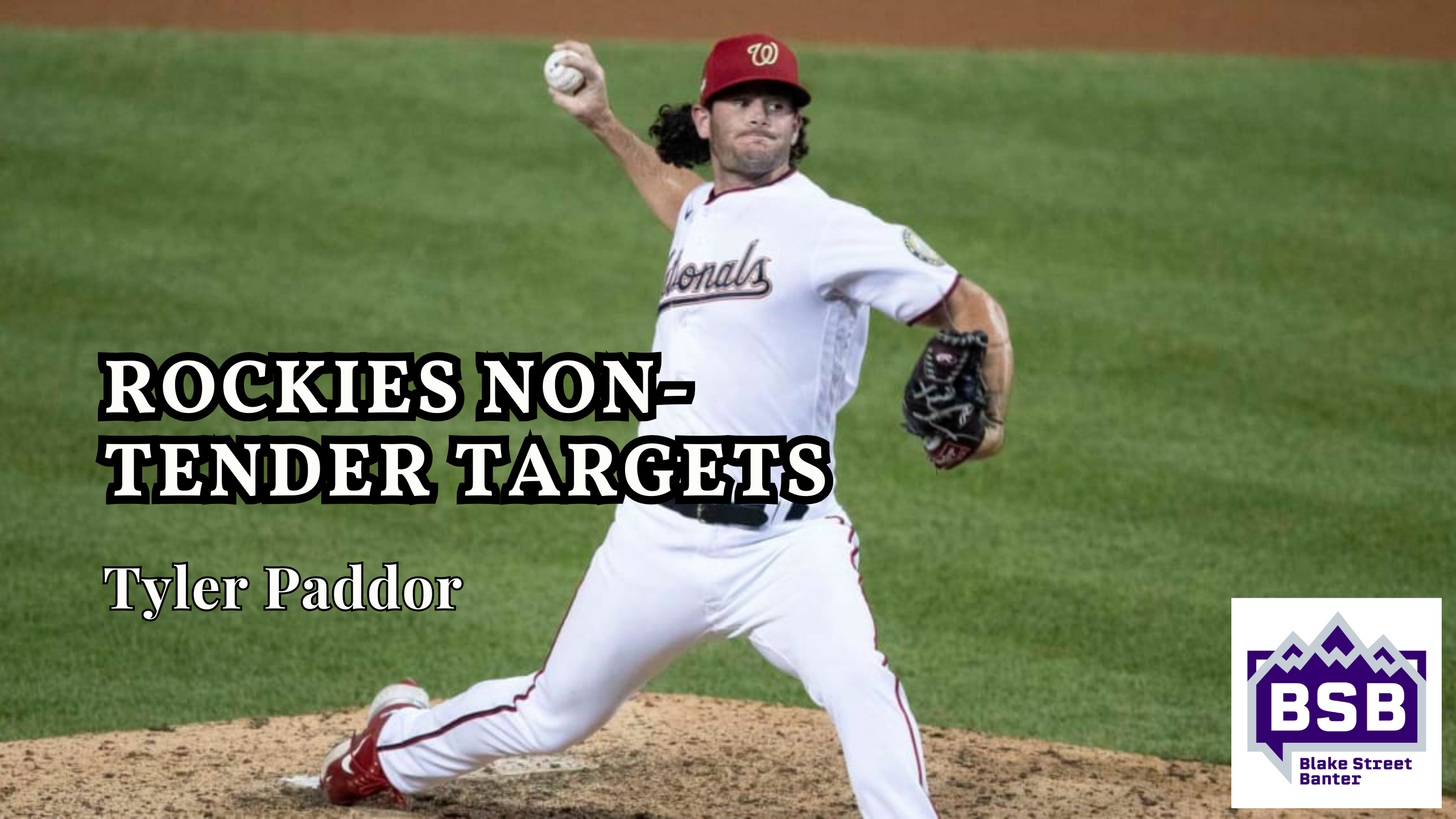
Every year, the non-tender deadline injects the free agent market with excitement. Obviously, these are players their former teams actively decided to move on from but that’s usually because of the value placed on 40-man spots and the extreme scrutiny placed on projected arbitration salaries.
In other words, good players get non-tendered. Just look to Brendan Rodgers and Cal Quantrill; neither have proven to be great players but both have been above replacement level their entire careers.
In terms of why those players got non-tendered, consider the concept of $ per WAR that every team effectively lives and dies by. Rodgers was projected for $5.5M while Quantrill was projected for $9M. With the market rate per WAR sitting around $6-8M, both players were due for contracts at or above the market rate (Rodgers = 0.8 fWAR in 2024, Quantrill = 0.5 fWAR in 2024).
Across the league, a handful of players in similar situations as Rodgers and Quantrill and with intriguing track records landed themselves on the free agent market. While the Rockies don’t have an abundance of space on their active roster, they just might be able to find a bargain addition to the 2025 roster to stabilize the squad and potentially standout as a trade piece come July.
Reinforcements for the Bullpen
We covered potential bullpen targets looking at the traditional free agent pool last week. Following the non-tender deadline, a handful of new names have emerged as fits, leaving the Rockies with options and perhaps a slightly cheaper market now that supply has gone up.
Jordan Romano
Since 2022, Romano ranks 8th in saves and between 2022 and 2023, he ranked 2nd in the league for saves as arguably a top 5 closer in baseball.
In 2024, Romano was only active for 44 days with elbow issues forcing him out for most of the season. In July, Romano had an arthroscopic surgery on his elbow–more of a minor clean-up operation–but he did not return amid the Blue Jays disappointing season.
Signing Romano comes with the obvious risk that he may never be the same shutdown reliever he was in the early 2020s, but there’s also clear upside. Even with the elbow issues this year, Romano still averaged 96.4 mph on his lively fastball, though it was far less effective this year amid feel issues.
As a two-pitch arm, Romano’s second pitch is a devastating upper-80s pitch with healthy drop that consistently misses bats. In terms of movement and velocity, it is one of the best breaking balls in the league because of its uniquely steep shape mixed with higher-end velocity.
Earlier in his career, Romano induced loads of ground balls, though between 2023 and 2024 that trend has changed. Without a clear indication why, there would be an open door for Romano to keep the ball on the ground more at Coors Field.
With his sterling reputation, Romano will surely have multiple suitors and any Rockies pursuit for his services would likely face an uphill battle.
Kyle Finnegan
Much like Romano, Finnegan has been a saves machine in recent years, finishing 4th in the saves department since 2023 with 66.
Finnegan has accomplished that feat with power. He averages 97.2 mph on his fastball and can touch 100 with some run that can get Finnegan out of jams. His upper-80s splitter can also be a day ruiner for hitters, with a batting average against of just .178 since 2023.
Unfortunately, the peripherals don’t support Finnegan being a great closer; he struck out just 22.1% of hitters this year with an 8.9% walk rate, both slightly below average marks. Finnegan also gives up his share of hard contact, ranking near the bottom of the league in hard-hit percentage the last two seasons.
It’s fair to say that is a testament to Finnegan’s pitching clutch, but it’s also safe to say there’s a reason the Nationals non-tendered one of MLB’s save leaders.
A key going forward for Finnegan will be fastball utilization. The heater gets hit a lot more than his splitter because he’s living in the zone and often catches too much plate. With some better fastball results, Finnegan could continue to thrive in the closer role but like Romano, there will be leaguewide interest.
Austin Voth
A lesser-known pitcher leaguewide, Voth emerged in the Mariners bullpen this season with a 3.69 ERA and 1.05 WHIP across 61 innings.
While Voth isn’t a flashy arm, he has good enough stuff and showed excellent feel for pitching in 2024–his second year as a full-time reliever. A balanced four-pitch arsenal, featuring a cutter, 4-seam, sweeper, and curveball, allows Voth to utilize unusual sequencing for a reliever.
While there is no plus go-to pitch, all four offerings are around average. In 2024, Voth’s curveball saw massive improvement, seeing the wOBA against drop from .387 to .147 and his whiff% spiking from 24.4% to 47.7% as he added about 3 more inches of drop to the curve.
As a flyball pitcher without elite stuff, Voth may not be a fit for the Rockies but good pitching is good pitching and Voth figures to be a serious bargain in this market.
Hunter Stratton
Like Voth, Stratton is a relative unknown to fans with just 49.2 innings under his belt. His 2024 season saw an impressive showing but ultimately the Pirates valued his 40-man spot more with plans to make free agent additions.
Stratton flashed enough to get interest on an MLB deal with his lively mid-90s 4-seam fastball. Stratton locates his fastball well which can be all you need with velo that touches 98.
Stratton also throws a cutter in the low-90s with healthy movement that has the makings of a plus MLB offering. It’s Stratton’s slider, however, that may ultimately be the best pitch of them all. It gets huge break like a sweeper but also gets healthy drop, making it a two-plane bat missing breaker.
The Pirates may have ultimately moved on from Stratton since he doesn’t have another pitch like a changeup or curveball to mix in to left-handers as Stratton gave up a whopping 21 hits to lefties (68 batters faced) versus just 16 to righties (90 batters faced).
Stratton will always be vulnerable to left-handed bats but his 3-pitch mix can be dominant against righties and should make him an interesting target.
Hoby Milner
Remember Brent Suter? Hoby Milner is practically the exact same pitcher, coming from the Brewers and all.
With a funky sidearm slot from the left-side and pair of upper-80s fastballs, Milner has to get by on deception and location–which he does admirably. Milner worked a stellar 5.2 BB% last season and allowed just 6 home runs across 61 innings, backed by a 53.7% groundball rate.
The star of the show here is a sweeper that works heavily to the glove side, staying down in the zone to induce weak contact.
Milner also throws a sinker–his ultimate groundball machine–and a 4-seamer that miraculously misses a ton of bats despite topping out at 91 because of how much arm-side run the pitch gets coming from an already devious arm slot.
Otherwise, Milner mixes in a changeup occasionally that tunnels well with both fastballs.
Again, this is the second coming of Brent Suter. What Milner lacks in power, he makes up for in every other way and could be a fun addition to the Rockies already diverse set of bullpen arms.
Potential Backend Starters
With the Rockies non-tendering Cal Quantrill and designating Peter Lambert for assignment, they will at least consider bringing in a starter or an arm that can function in a hybrid long-reliever/spot starter role. The non-tender deadline brought a handful of names into the mix.
Patrick Sandoval
Sandoval underwent Tommy John surgery in June which is a huge reason the Angels decided to move on from an arm that had flashed ace stuff, with the southpaw headed to arbitration for the final time with a projected 6M price tag.
While Sandoval has struggled with a 1.51 WHIP since 2023, there is still backend starter ability here, especially if Sandoval can get healthy. In his career, Sandoval owns a 4.01 ERA across 536 innings and is still just 28.
With a five-pitch mix, headed by an effective low-spin changeup and slider, Sandoval has the type of arsenal that can perform at Coors Field. As a big leaguer, Sandoval has not established a quality fastball and being unable to consistently buy early strikes impedes his success.
Sandoval struggles with command at times but he has a strong track record for missing bats and getting ground balls.
Coming off Tommy John surgery, a two-year deal loaded with incentives could make the Rockies and Sandoval a perfect match. With rotation injuries likely, Sandoval’s eventual July or August return could be well-timed.
Griffin Canning
A former teammate of Sandoval’s Canning has flashed mid-rotation upside at every step of his career but inconsistency has gotten the better of the UCLA product. In 2024, a drop in fastball velocity doomed Canning to a 5.19 ERA and 1.40 WHIP resulting in him being non-tendered.
What has not wavered is Canning’s dynamite slider and changeup combo. Both pitches are power offerings that miss bats and generate weaker contact.
Canning’s fastball was ultimately a detriment this year with 16 home runs against the pitch amid reduced velocity and poor location. After a poor showing in 2024, Canning may have to settle for an MiLB contract somewhere with potential rotation or long-relief openings (aka the Rockies).
If Canning can get back to the best version of himself, he’s a legit #4 starter and should at least upgrade the spot Peter Lambert held.
Ethan Small
The least proven pitcher included, Small is a former Future Games representative and top-5 prospect for the Milwaukee Brewers. Most recently in 2024, Small only logged 13 minor league innings after suffering a severe oblique strain in Spring Training. He struck out 16, walking just 2, though a 4.85 ERA shows damage was still done.
Small has exhibited elite control at certain points in his career with some quirky characteristics as a pitcher. The Mississippi State product has one of the highest arm slots in baseball after he gets a Kershaw-like knee bend in his wind up.
The arm slot allows Small to throw his pitches on an extremely steep plane which can be ideal for generating groundballs and typically weaker contact. In any event, it’s a unique slot for hitters to try and read.
Small primarily works with a fastball and changeup, though he flashed a quality breaking ball as well. The fastball-changeup tunnel can be very effective but Small has not had a real chance in recent years to establish his stuff.
With a mounting injury history, Small’s career as a starter may be over but his pedigree and stuff could be perfect for a multi-inning bullpen role.
A Former Top Positional Prospect
The Rockies are looking to develop a homegrown offensive core but one of the biggest drawbacks of recent Rockies clubs has been the bench. Can the Rockies use the rock tumbler to bring back the shine of a once dazzling top prospect?
Nick Madrigal
Madrigal was the 4th overall pick in a weak 2018 draft class, though Madrigal took just over a full year to reach the big leagues and he made an impact immediately, hitting .317 with the White Sox before being included in the trade package for Craig Kimbrel.
The skillset Madrigal was prided on has been present, however his Cubs tenure has been inconsistent. Madrigal runs one of the lowest strikeout rates in baseball and hardly swings and misses.
His approach is decent but he has little margin for error given that he’s rocking 20/30 grade power. Additionally, Madrigal’s speed has not been as advertised; his raw speed is roughly average and he’s stolen just 17 bases in 285 career games (caught 6 times).
Fortunately, Madrigal’s glove has also translated to the pros, finishing tied for 22nd in MLB last year for Outs Above Average (MLB’s proprietary metric that uses Statcast data), primarily playing third base with some second base mixed in.
It’s hard to know what you’re getting with Madrigal; will he continue being a sub .300 OBP guy with no power or can he return to form as a reliable slap hitter that plays quality defense at multiple infield spots? It’s worth taking the risk and trying to find a quality role player.
Leave a Reply