
Tyler Paddor | March 24, 2025
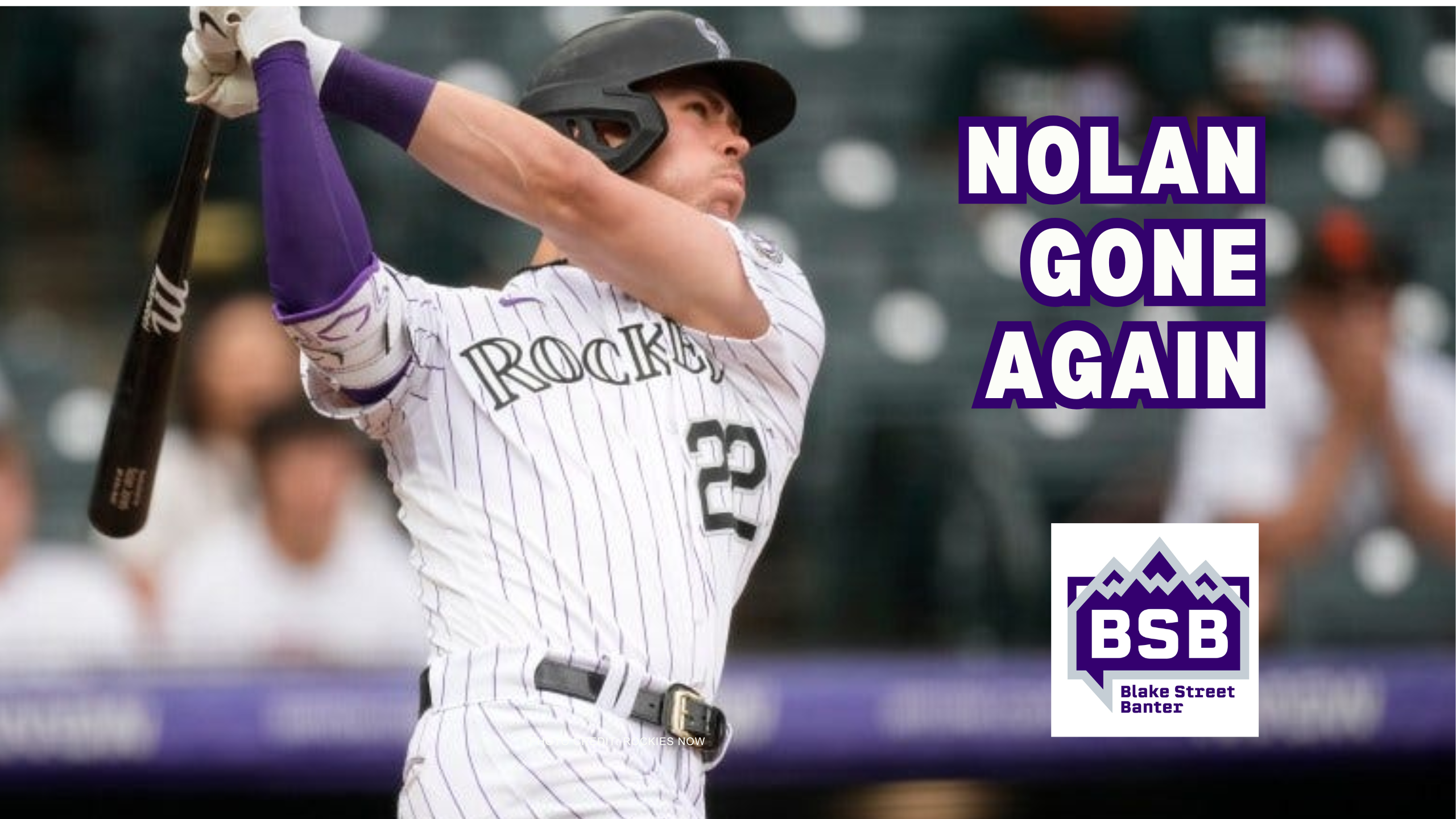
The Rockies swung a trade just days before Opening Day with Nolan Jones heading back to Cleveland for utilityman Tyler Freeman, the second notable (and arguably frustrating) trade of a Nolan in recent years for Colorado.
Nolan Jones’s Rocky Journey
After 2023, Jones looked like a potential face of the franchise for a team that hadn’t fully seen a breakout from either Ezequiel Tovar or Brenton Doyle. Jones managed to log a 20 HR/20 SB season as a rookie despite being in the minor leagues for the first month and a half of the season. His 137 wRC+ was the best mark for Colorado since Charlie Blackmon’s 142 wRC+ in 2017.
Jones tapered off heavily in 2024 amid injuries and general performance issues, some of which has been self-attributed to some trials and tribulations off the field as Jones wavered with confidence and managing expectations.
Jones finished the 2024 season with an undesirable .641 OPS and just 3 home runs in almost half a season’s worth of games. Further, Jones struggled on the defensive side, committing a few demoralizing errors and finishing with -6 OAA in half a season. Jones further slumped out of the gate in 2025 Spring Training, departing the organization with a .578 OPS in 50 PAs.
While returning to 2023 form is a longshot–more on that later–Jones will likely play better than his 2024 production, though by what margin is to be determined.
As a personal note, I was very high on Nolan Jones prior to his Rockies debut. In Triple-A, Jones looked very comfortable and in control of the zone every at bat, diverging from the passive nature some scouts picked on when Jones was first with Cleveland. Following 2023, it seemed like Jones may have made substantive changes, but in 2024 that’s exactly what plagued the Pennsylvania native.
Though injuries played a part, Jones displayed passive traits, indicating he was not always seeing, reading, or anticipating pitchers well. There’s a clear distinction between selectivity and passiveness and Jones tended to classify as the latter during his Rockies tenure.
Between 2023 and 2024, Jones’s zone-swing percentage ranked as the 7th lowest mark in the league at 58.4%, meaning that Jones swung at strikes at the 7th lowest rate in MLB. On its own, that can actually be a good thing. Wait for your pitch right? However, most players around Jones’s zone swing rate are high contact players and Jones’s below average 78.9% zone contact rate (26th lowest in MLB) is an outlier among hitters with similar swing tendencies.
No other player in MLB matched a sub-60% zone swing rate with a sub-80% zone contact rate. Further, among hitters who saw 200 or more pitches down the heart of the plate, Jones swung and missed at 20.7% of them, the 16th highest rate in MLB.
In simpler terms, what does this all mean? It means Jones not only lets a lot of hittable pitches go by but he simultaneously struggles to make contact on hittable pitches, creating an obstacle to sustainable MLB production.
Speaking of sustainability, in 2023, Jones had a .401 BABIP (batting average on balls in play), the singular highest mark in the league that year (400+ PAs). BABIP is a stat that typically regresses toward the league average year over year. The league average BABIP usually sticks around .300, though players who hit the ball hard may see BABIP figures in the .330-.340 range.
Nolan Jones’s 2024 was the case in chief to support this point. Jones’s BABIP cratered from the .401 mark down to a much more normal and sustainable .330 BABIP–still well above the league average but typical for a hitter like Jones who makes a lot of hard contact. The 71 point difference in BABIP is evident in the actual results for Jones with the outfielder seeing a drop in OPS from .931 to .641.
Assuming good health, Jones is better than a .641 OPS. He has huge raw power and that should allow him to hit his share of home runs, though without a better approach and attack plan, that power may go underutilized.
Beyond the bat, we know Jones is talented. He stole 20 bags in 2023 and led MLB in outfield assists with 19. That talent does not go away. Jones was not at his best defensively in 2024 but should be capable on that side of the ball going forward.
Cleveland is getting an uber-talented player with upside worth gambling on but there are clear downsides with Jones at the plate. The Rockies saw those downsides as reasons to move on as another down year for Jones would give the club good cause to non-tender him.
The timing of the trade is not quite ideal, however. If the Rockies were keen to move Jones, would the offseason not have been a better time to swing a trade?
With a disappointing Spring Training behind Jones and leverage weakened on the precipice of Opening Day, the Rockies surely did not get as much in return for Jones as they may otherwise have been able to. However, for reasons above, Jones was not a straightforward trade chip with teams likely wondering if it was worth betting on a substantial bounceback.
Rockies fans should keep an eye on the soon-to-be 27-year-old as he returns to a now crowded outfield that Cleveland has stacked up recently, overcompensating for a production void in the early 2020s.
Tyler Freeman’s Potential Rockies Impact
Flipping the coin over, the Rockies got back the versatile Tyler Freeman. The news comports with the wrist injury to Thairo Estrada that figures to sideline Estrada until late May or possibly even early June.
Freeman came through the minors as an infielder before starting to wade into the outfield in 2023 and then playing there primarily amid Cleveland’s dire need for outfield depth in 2024. Freeman will see time at second base but also in the outfield, as long as some of the organization’s top prospects are in the minors.
In 2022, before graduating as a prospect, Freeman ranked #5 in the Cleveland farm system and inside MLB’s Top 100 prospects. Freeman was viewed as a potential leadoff type hitter with some speed and defensive value at key positions.
While Freeman does have above average speed and the ability to play all sorts of premium spots (SS, CF, 3B, 2B), his bat has not translated to MLB thus far. Freeman’s .223 MLB batting average is a stark contrast from his career .313 MiLB average.
Freeman has given signs of hope with an exceedingly low strikeout rate and elite feel for contact. Freeman’s approach is simultaneously not bad with roughly average swing decisions, though the California prep product does swing a lot in an effort to make a lot of solid contact.
Freeman will always be held back by a lack of power. Freeman’s career average exit velocity of 87 mph is 1.5 mph below the recent league average of 88.5 mph and Freeman struggles to hit the ball hard and in the air, indicated by his meager career 2.9% barrel rate (measures balls hit over 95 mph within the desired launch angle range, strongly correlating with home run percentage). The league average barrel rate more than doubles that at 7%.
Freeman has struggled to do damage against fastballs at the major league level with just a .202 average against heaters this past season, though expected metrics suggested Freeman deserved better numbers (.245 xBA).
Plainly, there is not much upside to Freeman’s game and his margin for error is not particularly large with a lot of pressure on his high-contact bat to produce solid hit totals amid a home run ceiling set around 10 long balls.
Look for the 25-year-old to stabilize the second base spot while Estrada recovers and provide outfield depth along with a contact-first approach the Rockies are largely lacking among their current MLB hitters. Freeman does not figure to be an above average everyday player but he has a chance to carve out a long-term utility role for the Rockies.
Summary of the Trade
The timing of this trade does not present good optics. Trading a high upside player to acquire an injury replacement–though potential long-term utility piece–is not great practice, to say the least. However, it’s clear that Jones has some deep rooted flaws at the plate that he will need to overcome to find consistent success in his next chapter.
Unexpected Ripple Effect
With Jones traded, it seemed all but sure that young outfielder Zac Veen would break with the big league squad. Unfortunately, the Rockies opted for journeyman Nick Martini to provide a bench presence.
While the decision is frustrating, Veen has played just 109 MiLB games since the start of 2023 out of a possible 288 games with a serious wrist injury sapping his 2023 season and wrist and back injuries slowing him in 2024. Within that span, Veen’s .723 OPS does not exactly suggest he’s big league ready.
Veen played well in Spring Training, winning the Rockies Abby Greer Award–given to the Spring Training MVP, though it’s more development focused for young players and prospects–with an .825 OPS through today’s game (March 24). However, with a scouting report that points opposing pitchers to challenge him with high heat, Veen was neutralized by more prepared and seasoned pitchers, leading to a 29.4 K%.
This Spring Training experience should serve as momentum leading into Veen’s final development phase. Should the Floridian make slight strides early in the season at Albuquerque, he should be in line for a big league corner outfield role that he’ll hopefully never let go of.
Veen’s performance may have made the Rockies more confident in their corner outfield future, though the logic of the trade is watered down by Veen’s option to the minor leagues. With good health and solid production, Veen should be a big leaguer by the end of May. Meanwhile, fans will need to endure through another high dose of veteran play on a rebuilding MLB roster.
BSB’s Top 40 Rockies Prospects
Check out our number 1 prospect in the Rockies organization and find links to the entire top 40 series below.
Leave a Reply